
Sleeping on the floor may feel better for some people, but a hard floor is not automatically better for your spine or back pain.
Research comparing sleep surfaces generally suggests that a supportive medium-firm mattress performs better than a very firm surface for many people with chronic non-specific low-back pain. In one randomized trial, people sleeping on medium-firm mattresses had better pain and disability outcomes than those using firm mattresses. PubMed
The right sleeping surface depends on your:
- body type
- sleeping position
- underlying spine condition
- mattress support
- pain pattern
- personal comfort
The goal is not to sleep on the hardest possible surface. The goal is to keep your spine comfortably supported in a neutral position throughout the night.
If back pain repeatedly wakes you, worsens in the morning or travels into the leg, it may be worth getting the underlying cause evaluated instead of only changing your sleeping surface.
Is It Better to Sleep on the Floor or a Bed?
For most people, a supportive bed with an appropriate mattress is preferable to sleeping directly on a hard floor.
A very hard surface does not necessarily improve spinal alignment or back pain.
Evidence from mattress research generally favors medium-firm support over very firm surfaces for comfort, spinal support and low-back pain outcomes. A recent orthopedic literature review likewise found that medium-firm mattresses had the most consistent support in the evidence reviewed.
Some people may temporarily feel comfortable on the floor because the surface is firmer than a sagging or very soft mattress. That does not mean the floor itself is therapeutic.
Sleeping on the Floor vs Bed: Main Differences
| Factor | Sleeping on the floor | Sleeping on a supportive bed |
|---|---|---|
| Surface firmness | Very firm/hard | Can be selected according to comfort |
| Pressure relief | Usually lower | Better with an appropriate mattress |
| Spinal support | Depends on body shape and position | Can provide balanced support |
| Ease of getting up | More difficult | Usually easier |
| Comfort for shoulders/hips | Often reduced | Better pressure distribution |
| Suitable for older adults | Often less practical | Usually easier and safer |
| Evidence for back pain | Limited | Better evidence for medium-firm mattresses |
Is Sleeping on the Floor Good or Bad?
There is no universal answer.
Sleeping on the floor may feel comfortable to some healthy adults, particularly if their existing mattress is extremely soft, sagging or poorly supportive.
However, a floor can also create excessive pressure around areas such as the:
- shoulders
- hips
- pelvis
- heels
For some people, this can worsen discomfort or interrupt sleep.
Sleep quality itself matters because poor sleep and chronic musculoskeletal pain can reinforce one another. Research shows a bidirectional relationship between sleep problems and chronic musculoskeletal pain.
So a surface that repeatedly causes poor sleep is not necessarily beneficial simply because it feels “firm.”
Does Sleeping on the Floor Help Back Pain?
Sometimes people report temporary relief after moving from a soft, sagging mattress to the floor.
That may happen because the floor reduces excessive sinking.
But there is not strong evidence that sleeping directly on a hard floor is an effective treatment for back pain.
Research looking at mattress firmness has actually found better outcomes with medium-firm mattresses compared with firm mattresses for chronic non-specific low-back pain. PubMed
A literature review of mattress design and back pain similarly concluded that medium-firm mattresses generally promote better comfort, sleep quality and spinal alignment than extremes of firmness. PubMed
Key takeaway
If your current mattress is very soft or sagging, improving support may help.
That does not necessarily mean moving all the way to a hard floor.
Is Sleeping on the Floor Good for Your Back?
For some people, perhaps.
For others, no.
The effect depends on your anatomy, sleeping position and cause of back pain.
A hard floor can reduce sinking, but it also provides little contouring around natural curves of the body.
People with:
- prominent hips
- broad shoulders
- low body weight
- arthritis
- joint pain
may find a hard floor uncomfortable because it increases pressure at contact points.
If you wake with more stiffness or pain after sleeping on the floor, that is a sign the surface may not suit you.
What Is the Best Surface to Sleep On for Back Pain?
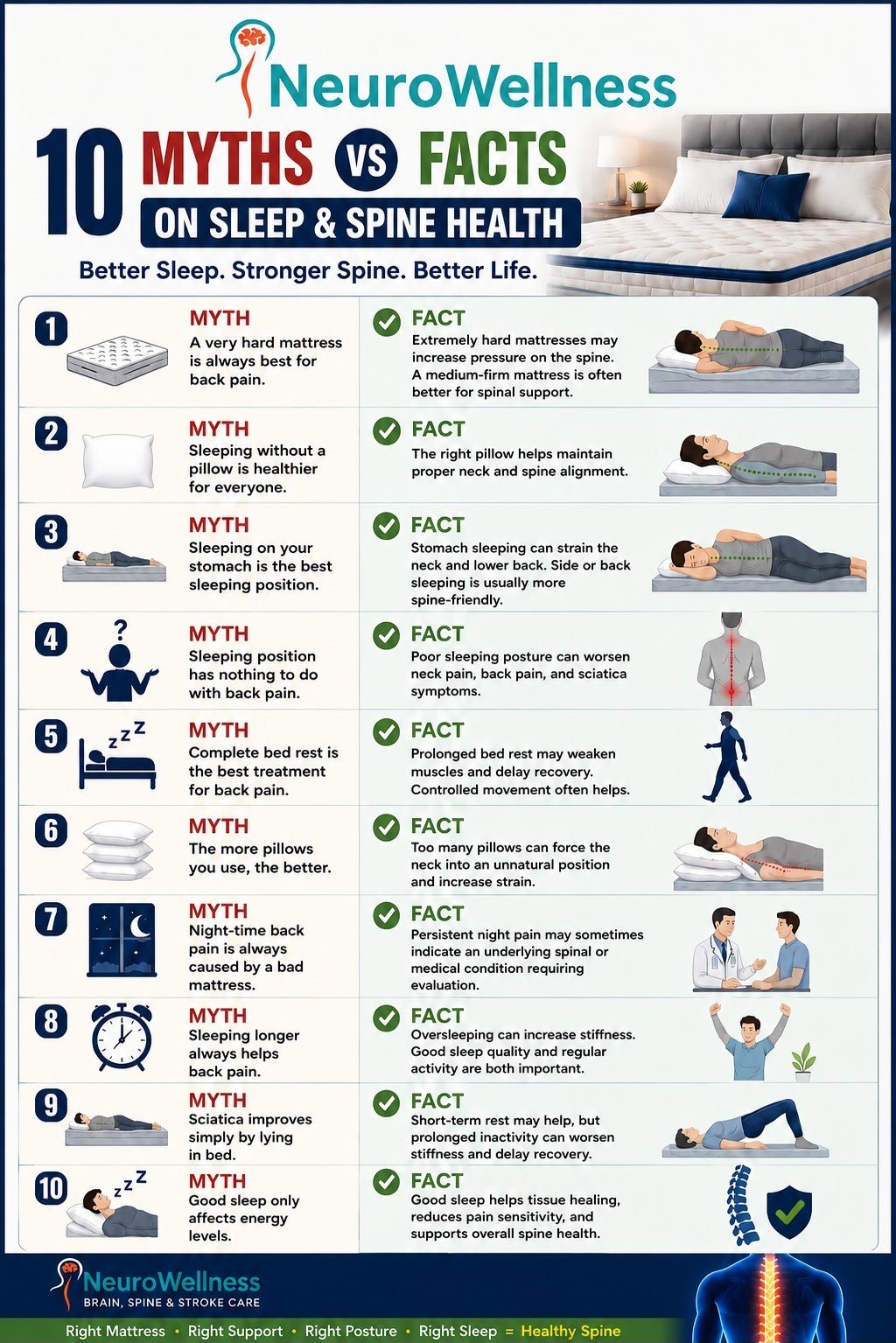
The evidence does not support a simple “harder is better” rule.
For many people with non-specific low-back pain, a medium-firm mattress appears to be a reasonable starting point.
The classic randomized trial involving 313 adults with chronic non-specific low-back pain found better outcomes with a medium-firm mattress than a firm mattress over 90 days. PubMed
More recent reviews have generally reached similar conclusions, although mattress materials and individual preferences vary. PubMed
A good sleep surface should:
- support the natural curves of your spine
- prevent excessive sinking
- reduce pressure on shoulders and hips
- allow you to change positions comfortably
- help you wake without increased pain or stiffness
Is Sleeping on a Hard Surface Good or Bad?
A hard surface is not automatically better for the back.
If the surface is excessively hard, pressure may build around the shoulders, hips and pelvis.
That can cause discomfort and may alter sleeping posture during the night.
In mattress studies, very firm surfaces have generally not performed as well as medium-firm ones for people with chronic low-back pain. PubMed
When firmness may feel helpful
A firmer surface may feel better if your current mattress:
- sags significantly
- allows the pelvis to sink
- feels unstable
- is extremely soft
In that situation, the problem may be inadequate mattress support, not the fact that you are sleeping on a bed.
Floor vs Firm Mattress: Are They the Same?
No.
A firm mattress still provides some cushioning and distributes pressure across the body.
A hard floor generally offers far less pressure relief.
That distinction matters.
A surface can provide good spinal support without being extremely hard.
For many people, the best compromise is medium-firm support with enough cushioning to accommodate the shoulders, hips and natural curves of the spine.
Best Sleeping Position for Back Pain
The surface matters, but so does your sleeping position.
A recent systematic review found that sleeping posture can influence low-back pain, with supine sleeping generally supporting spinal alignment, while prone sleeping may increase lumbar strain. Side sleeping can also work well when alignment is supported appropriately. PubMed
Sleeping on your back
Back sleeping can help maintain a relatively neutral spine.
Try:
- lying on your back
- using a comfortable head pillow
- placing a small pillow under the knees if this feels better
A pillow under the knees may reduce tension through the lower back for some people.
Sleeping on your side
Side sleeping is comfortable for many people.
Try:
- keeping the head aligned with the spine
- using a pillow of appropriate height
- placing a pillow between the knees
The knee pillow can reduce rotation through the pelvis and lower back.
Sleeping on your stomach
Stomach sleeping may increase arching through the lower back and requires the neck to remain turned to one side.
Some people tolerate this position well, but for those with back or neck pain it may aggravate symptoms.
The systematic review on sleep posture found prone sleeping was associated with greater low-back strain in the available evidence.
Should You Sleep on the Floor for Lower Back Pain?
I would not recommend sleeping on the floor as a general treatment for lower-back pain.
First consider why the back hurts.
Common causes can include:
- muscular strain
- prolonged sitting
- poor conditioning
- disc-related pain
- degenerative changes
- facet joint irritation
- nerve compression
Changing the sleeping surface may improve comfort, but it does not necessarily address the underlying problem.
If you have persistent low-back pain, NeuroWellness provides spine evaluation and treatment in Bangalore.
For conservative rehabilitation, you can also explore physiotherapy at NeuroWellness.
What If Sleeping on the Floor Makes My Back Feel Better?
If sleeping on a firm surface genuinely feels better, that information can be useful.
It may indicate that your current mattress is:
- too soft
- sagging
- no longer supportive
- poorly suited to your sleeping position
Before permanently moving to the floor, consider trying a supportive medium-firm mattress.
Research suggests the right sleep surface can influence pain, stiffness and sleep comfort in people with chronic back pain.
Keep in mind that short-term comfort does not necessarily mean the surface is ideal for long-term spinal health.
Who Should Be Careful About Sleeping on the Floor?
Floor sleeping may be particularly inconvenient or uncomfortable for:
- older adults
- people with arthritis
- people with hip or shoulder pain
- people who have difficulty getting up from the floor
- people recovering from spine surgery
- people with significant mobility limitations
- people who experience numbness or pressure discomfort
If you have recently undergone spine surgery, follow your surgeon’s instructions rather than changing sleeping surfaces independently.
For surgical recovery guidance, visit NeuroWellness spine surgery care.
What Type of Mattress Is Best for Spine Health?
There is no single mattress suitable for everybody.
However, research overall tends to support medium-firm mattresses rather than extremely hard mattresses for people with non-specific low-back pain. PubMed
Look for a mattress that:
- feels supportive without being painfully hard
- does not sag significantly
- allows your shoulders and hips to settle comfortably
- keeps your spine reasonably aligned
- works with your usual sleeping position
Side sleepers
Often need more pressure relief around the shoulder and hip.
Back sleepers
May prefer a more evenly supportive surface.
Stomach sleepers
May need to avoid excessive sinking around the pelvis.
Body weight and individual comfort also matter.
When Should You Replace Your Mattress?
There is no universal replacement age.
Consider replacing or reassessing the mattress if:
- it has visible sagging
- you regularly wake with pain or stiffness
- you sleep better on other beds
- the mattress no longer provides even support
- discomfort improves when you change sleeping surfaces
Do not replace an otherwise comfortable mattress solely because someone says hard mattresses are healthier for the spine.
Is Back Pain in the Morning Always Caused by the Mattress?
No.
Morning back pain can have many causes.
These may include:
- sleeping position
- muscle stiffness
- prolonged inactivity
- an unsuitable mattress
- disc or joint problems
- inflammatory conditions
- poor sleep quality
If morning pain improves shortly after moving, it may be mechanical.
But persistent, severe or progressive pain deserves medical assessment.
When Back Pain Needs Medical Evaluation
Do not rely only on changing the bed or sleeping on the floor if your symptoms include:
- pain lasting several weeks
- leg pain or sciatica
- numbness or tingling
- leg weakness
- balance difficulty
- worsening pain
- pain following significant injury
- bowel or bladder changes
These symptoms can indicate conditions that require proper clinical evaluation.
Book a Spine Consultation at NeuroWellness, Bangalore →

Dr. Ganesh Veerabhadraiah
Consultant – Neurosurgeon, Neurointerventional Surgery, Spine Surgeon (Neuro)
23+ Years Experience Overall (17+ years as Neuro Specialist)
Available for Consultation: Jayanagar 9th Block & Kauvery Hospital, Electronic City
Simple Sleep Setup for Better Spine Comfort
Instead of asking only “floor or bed?”, try optimizing your whole sleep setup.
If you sleep on your back
- use a supportive mattress
- keep your head comfortably aligned
- consider a pillow under your knees
If you sleep on your side
- choose enough cushioning for the hip and shoulder
- use a supportive head pillow
- consider a pillow between the knees
If you sleep on your stomach
- avoid excessive arching of the lower back
- consider whether another position feels more comfortable if pain persists
Most importantly
Choose the position and surface that allows you to sleep comfortably without worsening symptoms overnight or in the morning.
Frequently Asked Questions
1. Is it better to sleep on the floor or a bed?
For most people, a supportive bed is more practical than sleeping directly on a hard floor. Research on people with chronic non-specific low-back pain generally favors medium-firm mattresses over very firm surfaces. PubMed
2. Does sleeping on the floor help back pain?
There is not strong evidence that floor sleeping itself treats back pain. Some people may feel better on the floor if their existing mattress is extremely soft or sagging, but a supportive medium-firm mattress is generally a better evidence-based option.
3. Is sleeping on the floor good for your back?
It may feel comfortable for some people, but it can increase pressure around the hips and shoulders in others. Comfort, body type, sleeping position and the underlying cause of back pain all matter.
4. Is sleeping on a hard surface good or bad?
Very hard surfaces are not automatically healthier. Evidence suggests medium-firm support may produce better back-pain outcomes than very firm surfaces.
5. What is the best surface to sleep on for lower-back pain?
A supportive medium-firm mattress is a reasonable starting point for many people with non-specific low-back pain, although individual comfort and sleeping position should also guide the choice.
6. Is a firm mattress good for back pain?
A mattress should provide adequate support, but firmer is not necessarily better. In a randomized trial, medium-firm mattresses performed better than firm mattresses for chronic non-specific low-back pain. PubMed
7. Which sleeping position is best for lower-back pain?
Back sleeping with good support or properly aligned side sleeping may be comfortable for many people. A recent review found supine sleeping was generally associated with better spinal alignment, while prone sleeping could increase lumbar strain. PubMed
8. Can sleeping on the wrong mattress cause back pain?
An unsuitable or sagging mattress can contribute to discomfort and poor sleep in some people. Mattress support, sleeping position and individual body characteristics all affect comfort.
9. Should I sleep on the floor if I have a slipped disc?
Do not assume a hard floor is appropriate for a disc problem. The best sleeping setup depends on symptoms and the location/severity of the problem. Persistent radiating pain, numbness or weakness should be medically evaluated.
10. When should back pain be checked by a spine specialist?
Seek evaluation if pain persists, worsens or is associated with leg pain, numbness, weakness, balance problems or bowel/bladder symptoms.
Conclusion: Floor or Bed — Which Is Better for Your Spine?
For most people, the answer is not:
“The harder the surface, the better.”
The better goal is a sleep surface that:
- supports your spine
- reduces excessive pressure
- matches your sleeping position
- lets you sleep comfortably
- does not worsen morning pain
Research generally favors medium-firm mattresses over very firm surfaces for chronic non-specific low-back pain. PubMed
If sleeping on the floor seems better than your current bed, your mattress may simply be too soft or poorly supportive.
And if persistent back pain continues regardless of where you sleep, the next step should be identifying the underlying cause.
Medically reviewed by Dr Ganesh Veerabhadraiah, Senior Neurosurgeon & Spine Specialist, NeuroWellness Brain & Spine Care, Bengaluru. Last reviewed: September 2026.


Comments are closed.