
Written and medically reviewed by Dr Ganesh Veerabhadraiah, Senior Neurosurgeon & Spine Specialist, NeuroWellness Brain & Spine Clinic, Bengaluru. Last reviewed: September 2026.
A cervical collar, also called a neck collar, neck brace or cervical orthosis, is a medical support device used to limit movement of the neck in selected cervical spine conditions, injuries and after some procedures.
Cervical collars range from soft foam collars that provide light support to rigid collars designed to restrict neck movement more substantially. The correct type, fit and duration depend on the reason it was prescribed, your symptoms, imaging findings and your treating specialist’s advice.
A cervical collar is not a routine treatment for everyday neck stiffness or posture-related neck pain. For many common types of neck pain, keeping the neck gently mobile is preferable unless a doctor has specifically advised immobilisation.
If you have persistent neck pain, arm pain, numbness or weakness, you can consult the NeuroWellness team for a spine and neurosurgery evaluation. NeuroWellness provides brain and spine care through its Bengaluru clinics.
What is a cervical collar used for?
A doctor may recommend one for selected neck injuries, some cervical spine conditions, after certain surgeries, or when temporary restriction of neck movement is required.
How long should you wear a cervical collar?
There is no single duration that is appropriate for everyone. It depends on the diagnosis, type of collar, healing progress and instructions from your treating doctor.
Can you sleep with a cervical collar?
Some people prescribed a rigid collar are advised to keep it on while sleeping, whereas other patients may be allowed to remove their collar. Follow the instructions given for your specific condition. NHS hospital guidance similarly advises patients prescribed rigid collars not to remove them during sleep unless their clinical team says otherwise.
Can wearing a cervical collar too long cause problems?
Prolonged rigid-collar use can contribute to pressure injuries, skin problems, swallowing difficulty and other complications, which is why medical supervision is important.
What Is a Cervical Collar?
A cervical collar is an orthotic device worn around the neck to provide support and restrict some movement of the cervical spine.
The cervical spine consists of seven vertebrae in the neck and surrounds the spinal cord while allowing movement of the head and neck. A collar may be used when a clinician wants to reduce movement temporarily while an injury or surgical area is assessed or heals.
Different collars provide different levels of support. A soft collar may mainly provide comfort and a reminder to limit movement, whereas a rigid collar is designed to restrict movement more substantially.
Because the underlying reason for neck pain varies considerably, patients should avoid buying and using a collar for prolonged periods without knowing the cause of their symptoms.
If your pain travels from the neck into the arm or is associated with numbness or weakness, read our guide to cervical disc prolapse/PIVD.
What Is a Cervical Collar Used For?
The purpose of a cervical collar is to provide temporary neck support or movement restriction when clinically appropriate.
A doctor may recommend a cervical collar in situations such as:
- selected cervical spine injuries
- temporary immobilisation after significant neck trauma
- certain stable cervical fractures under specialist supervision
- recovery after selected cervical spine procedures
- short-term support in certain acute cervical conditions
- selected cases of cervical spondylosis or radicular pain when clinically appropriate
A cervical collar should not automatically be used for every episode of neck pain. The NHS specifically advises against routine neck-collar use for ordinary neck pain unless a doctor tells the patient otherwise.
Neck pain without injury
For posture-related neck pain, muscle stiffness and many uncomplicated neck-pain conditions, treatment may instead involve movement, ergonomics, rehabilitation and appropriate exercises.
NeuroWellness offers physiotherapy and rehabilitation services in Bangalore, including care for neck and spine-related problems. NeuroWellness
You can also read the NeuroWellness guide to neck-pain exercises and when to stop.
Types of Cervical Collars
Different cervical collars provide different levels of support. The right type should be selected according to the condition being treated rather than simply choosing the firmest collar available.
| Cervical collar type | Support level | Common clinical context |
|---|---|---|
| Soft cervical collar | Light | Temporary support in selected non-surgical conditions |
| Hard / rigid collar | Higher | Selected injuries or post-operative care when prescribed |
| Philadelphia collar | Rigid | Immobilisation in selected trauma or post-operative situations |
| Miami J collar | Rigid | Cervical immobilisation when specifically prescribed |
| Halo device | Very high | Specialist management of selected cervical instability/injuries |
Soft cervical collar
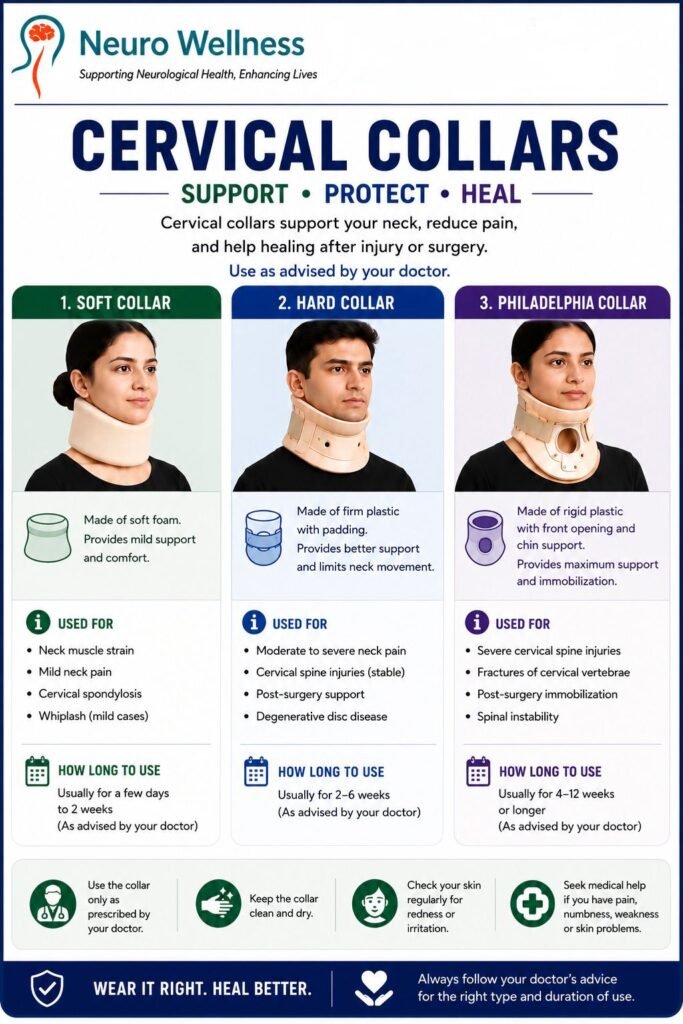
A soft cervical collar is usually made from foam covered with fabric. It provides relatively light support and does not immobilise the cervical spine as completely as a rigid device.
It may be considered for short-term use in selected patients, depending on the diagnosis and clinician’s advice.
Because prolonged immobilisation can contribute to stiffness and reduced muscle conditioning, a soft collar should not become an indefinite solution for chronic neck pain.
Hard or rigid cervical collar
A rigid collar uses firmer materials to restrict neck movement more substantially.
It may be prescribed after certain cervical spine injuries or procedures. Patients using a rigid collar should follow their surgical or medical team’s instructions closely regarding:
- how long to wear it
- whether it must remain on while sleeping
- when it may be removed for skin care or hygiene
- when follow-up imaging or review is required
Philadelphia collar
A Philadelphia collar is a type of rigid cervical orthosis with front and back sections.
It is used when greater restriction of neck movement is required. It should be fitted and managed according to the treating team’s instructions.
Miami J collar
The Miami J is another rigid cervical collar designed to provide cervical support and motion restriction.
Correct sizing and fitting are important because a poorly fitted rigid collar can create pressure points and skin irritation.
Halo device
A halo device provides much greater immobilisation than a routine soft or hard neck collar and is used only in selected specialist situations.
It is managed by an appropriate spine, neurosurgical or trauma team rather than self-fitted by patients.
Soft Collar vs Hard Cervical Collar
The main difference is the degree of motion restriction.
Soft cervical collar
A soft collar:
- provides light support
- permits more neck movement
- may be used temporarily in selected non-surgical situations
- should not be assumed to treat the underlying cause of chronic neck pain
Hard cervical collar
A rigid collar:
- restricts neck movement more substantially
- may be prescribed after certain injuries or procedures
- requires careful fitting
- may require continuous wear depending on medical instructions
There is no universally “best” cervical collar.
The best option is the collar that is appropriate for the underlying diagnosis and has been correctly fitted and prescribed.
If you have been advised surgery or are unsure whether surgery is actually required, NeuroWellness also provides a brain and spine surgery second-opinion service, where existing MRI/CT reports and treatment recommendations can be reviewed.
Cervical Collar for Cervical Spondylosis
One of the most common questions patients ask is whether a neck collar is good for cervical spondylosis.
Cervical spondylosis refers to degenerative changes affecting the discs, joints and other structures in the neck. Symptoms can include neck pain and stiffness and, in some people, arm pain, tingling or weakness if nerves are affected.
A collar may sometimes be used for temporary symptom support, but it is not a long-term treatment for the degenerative process itself.
Is a neck collar good for cervical spondylosis?
It may be appropriate for some patients for limited periods, but it should not be self-prescribed as a permanent treatment.
For uncomplicated neck pain, maintaining movement is generally encouraged rather than routinely immobilising the neck. nhs.uk
Which cervical collar is used for spondylosis?
When a collar is considered appropriate for a non-surgical condition, a clinician may choose a softer form of support rather than a rigid post-operative collar.
However, the choice depends on:
- symptoms
- neurological examination
- imaging where required
- whether there is nerve or spinal-cord involvement
- the reason support is being prescribed
Can I wear a cervical collar every day for spondylosis?
Continuous long-term use should not be started without medical advice.
If you depend on a collar because neck pain returns whenever you remove it, the underlying problem should be reassessed rather than simply increasing collar use.
For rehabilitation and strengthening options, see NeuroWellness physiotherapy services.
How Long Should You Wear a Cervical Collar?
There is no universal safe duration that applies to every cervical collar user.
How long you need a collar depends on:
- why it was prescribed
- whether the collar is soft or rigid
- whether there has been surgery or trauma
- symptoms and neurological findings
- imaging and evidence of healing
- your doctor’s follow-up assessment
| Situation | General approach |
|---|---|
| Uncomplicated everyday neck stiffness | A collar is usually not routinely recommended |
| Selected non-surgical neck conditions | Short-term or intermittent use may be advised |
| Cervical injury | Duration depends on injury type and stability |
| After cervical spine surgery | Follow the surgeon’s individual post-operative protocol |
| Cervical fracture | Follow specialist advice and imaging-based review |
Post-operative collar practice can vary according to the procedure and surgeon. A 2024 systematic review found that collar use after cervical spine surgery remains an area where benefits vary by procedure, so a fixed duration should not be presented as appropriate for every patient.
How long should you wear a soft cervical collar?
Use it for the duration specifically advised for your diagnosis.
If pain continues after the prescribed period or you feel unable to function without the collar, arrange reassessment rather than continuing it indefinitely.
Cervical collar after surgery
Post-operative instructions depend on the procedure and the surgeon.
For more detailed information, read:
How Long Should You Wear a Cervical Collar After Surgery?
This keeps post-operative advice separate from general cervical-collar guidance and avoids using one duration for every operation.
How to Wear a Cervical Collar Correctly
Correct fit matters.
A poorly fitted collar may provide inadequate support or create unnecessary pressure on the skin.
General fitting principles include:
- Keep the head and neck in the position advised by your treating team.
- Position the collar so the chin is appropriately supported.
- Fasten the collar securely according to the manufacturer’s or clinician’s instructions.
- Make sure it is snug but does not interfere with breathing.
- Do not cut, reshape or modify a rigid collar yourself.
- Check the skin regularly for persistent redness, soreness or breakdown.
Guy’s and St Thomas’ NHS guidance similarly advises patients to ensure the collar is snug without interfering with breathing and to inspect the skin regularly. Guy’s and St Thomas’ NHS Trust
Skin care while wearing a neck collar
Keep the skin and collar lining clean and dry.
Watch contact areas including:
- chin
- jaw
- back of the head
- sides of the neck
- upper chest/collarbone region
Contact your clinical team if you notice persistent redness, blisters, broken skin or increasing discomfort.
Can You Sleep With a Cervical Collar?
This depends on why the collar was prescribed.
Patients using rigid collars for an injury or after certain procedures may be instructed to keep the collar on while sleeping.
Hospital guidance for prescribed rigid collars commonly advises keeping the neck in a neutral position while sleeping and not removing the collar at night unless specifically instructed. Leeds Teaching Hospitals NHS Trust
Sleeping with a hard cervical collar
If your clinical team has instructed you to keep it on:
- follow their instructions even if symptoms feel better
- keep the head and neck in a neutral position
- use pillows in a way that does not force the neck forward
- avoid sleeping face-down
- follow the recommended technique for getting in and out of bed
Sleeping with a soft cervical collar
Some patients using a soft collar for a non-surgical condition may be allowed to remove it at night.
Do not assume this applies to you if the collar was prescribed for an injury or after surgery.
If there is any uncertainty, ask the clinician who prescribed the collar.
Cervical Collar Side Effects
Cervical collars can be useful when appropriately prescribed, but prolonged or poorly managed immobilisation can also cause complications.
A systematic review of prolonged hard-collar use reported complications including pressure ulcers and dysphagia, with pressure injury being one of the most frequently reported problems. PubMed
Possible cervical collar side effects include:
Skin irritation
Heat, moisture and friction beneath the collar can irritate the skin.
Regular skin checks are particularly important with rigid collars.
Pressure sores
A rigid collar can concentrate pressure around areas such as the chin, jaw and back of the head.
Persistent redness or broken skin should be assessed.
Swallowing discomfort
Some people experience difficulty or discomfort swallowing when wearing a rigid collar. Dysphagia has been reported among complications associated with prolonged hard-collar immobilisation.
Neck stiffness or muscle deconditioning
Keeping the neck immobilised for prolonged periods can contribute to stiffness and reduced muscle conditioning.
NHS hospital patient guidance also notes that long-term collar use can contribute to neck-muscle stiffness and weakness.
Restricted movement and visibility
Because a rigid collar limits neck rotation, activities requiring free head movement can become unsafe.
Patients should not drive while wearing a cervical collar that restricts movement.
When Should You NOT Use a Cervical Collar?
A neck collar generally should not be treated as a default solution for:
- ordinary desk-related neck stiffness
- temporary posture-related soreness
- mild uncomplicated neck pain
- prolonged preventive use while working
- self-treatment without knowing the cause of persistent symptoms
For uncomplicated neck pain, the NHS advises maintaining neck movement rather than routinely wearing a collar unless a clinician advises otherwise.
If your neck pain is related to prolonged screen use or workstation posture, read:
Text Neck Pain Treatment and Prevention
For guided rehabilitation, visit:
When Should You Contact a Doctor?
Arrange medical assessment if neck symptoms are persistent, worsening or associated with neurological symptoms.
Seek prompt medical attention if you develop:
- new or worsening arm weakness
- numbness or tingling that is progressing
- difficulty walking or maintaining balance
- severe neck pain following significant trauma
- breathing difficulty while wearing the collar
- significant swallowing difficulty
- new skin breakdown beneath a rigid collar
- increasing symptoms despite prescribed treatment
If your symptoms suggest a disc or nerve problem, you may also find the Cervical PIVD guide useful.

Dr. Ganesh Veerabhadraiah
Consultant – Neurosurgeon, Neurointerventional Surgery, Spine Surgeon (Neuro)
23+ Years Experience Overall (17+ years as Neuro Specialist)
Available for Consultation: Jayanagar 9th Block & Kauvery Hospital, Electronic City
Cervical Collar FAQs
A cervical collar is used to provide temporary neck support or restrict movement in selected cervical injuries, after some procedures and in certain cervical-spine conditions. It should be used according to a clinician’s recommendation rather than routinely for ordinary neck pain.
Common types include soft foam collars, rigid cervical collars, Philadelphia collars, Miami J collars and specialist immobilisation devices such as halo systems. They provide different levels of support and are not interchangeable.
There is no standard duration suitable for everyone. Wear it for the period recommended for your specific condition and arrange reassessment if symptoms persist.
Sometimes. Patients prescribed a rigid collar may need to wear it overnight, while some people using a soft collar may be allowed to remove it. Follow the instructions given by your treating clinician.
It may provide temporary support in selected patients, but it is not a long-term treatment for cervical spondylosis. Rehabilitation, appropriate exercise and treatment of the underlying problem are usually more important.
Potential problems include skin irritation, pressure injuries, swallowing discomfort, stiffness and muscle deconditioning, particularly with prolonged rigid immobilisation.
Neither is universally better. A soft collar offers lighter support, while a rigid collar restricts movement more substantially. The appropriate choice depends on the diagnosis.
Driving should be avoided when the collar restricts your ability to turn your head safely. NHS guidance specifically advises against driving while wearing a cervical collar that restricts neck movement.
Do not begin neck exercises while immobilisation has been prescribed unless your treating clinician or physiotherapist has cleared you to do so.
After clearance, rehabilitation may be used to restore mobility and strength. See the NeuroWellness neck pain exercise guide.
Consider specialist assessment if pain persists despite conservative treatment or is accompanied by radiating arm pain, numbness, weakness, balance problems or other neurological symptoms.