

After cervical spine surgery, most patients wear a hard collar for 6 to 12 weeks. Single-level ACDF: 6–8 weeks. Two-level fusion: 8–10 weeks. Three or more levels: 10–12 weeks. Cervical disc replacement: 4–6 weeks. Posterior decompression: 4–6 weeks soft collar. The exact duration is determined by your surgeon based on follow-up imaging — never stop early because you feel better.
The cervical collar prescribed after neck surgery is not optional and not a matter of personal comfort preference. It protects the surgical hardware, guides the bone fusion process, and prevents movements that could undo the repair your surgeon has completed. The most common question patients ask after being discharged — and one of the most important — is how long this collar needs to stay on.
This guide gives you the answer by surgery type, explains what determines your specific duration, covers how to wear the collar correctly at night and during daily activities, and tells you what the warning signs are that mean you need to call your surgical team immediately.a
Cervical collar duration - by surgery type
The duration of collar use after cervical spine surgery is not the same for every procedure. It depends on the type of surgery performed, the number of spinal levels involved, and your surgeon’s assessment at follow-up. The table below gives typical durations — your specific prescription may differ based on your individual case.
| Surgery type | Collar type | Typical duration | Night use? | Key reason |
|---|---|---|---|---|
| ACDF — 1 level | Hard collar | 6–8 weeks | Yes — 24 hrs | Protects fusion while bone bridges the disc space |
| ACDF — 2 levels | Hard collar | 8–10 weeks | Yes — 24 hrs | More fusion sites = longer stabilisation needed |
| ACDF — 3+ levels | Hard collar | 10–12 weeks | Yes — 24 hrs | Multi-level fusion is slower to consolidate |
| Cervical disc replacement (CDR) | Soft or semi-rigid | 4–6 weeks | Sometimes | No fusion required — motion preserved at implant |
| Posterior cervical decompression / foraminotomy | Soft collar | 4–6 weeks | Often not needed | No fusion — soft tissue support only during healing |
| Cervical laminoplasty | Semi-rigid or hard | 6–8 weeks | Yes initially | Bone flap healing requires stabilisation |
| Occipito-cervical fusion (skull to spine) | Hard collar | 12–16 weeks | Yes — 24 hrs | Complex multi-level fusion — longest duration |
| Halo vest removal → collar | Hard collar transition | 4–8 weeks post-halo | Yes | Bridging period after halo removal before full mobility |
These are typical ranges – not guaranteed durations
The table above shows typical ranges used in clinical practice. Your actual duration will be determined by your neurosurgeon at your post-operative follow-up appointment based on your imaging, your bone density, the surgical technique used, and how your recovery is progressing. Do not use this table to decide when to stop wearing your collar — that decision belongs to your surgeon.
Collar duration explained - surgery by surgery
6–12 weeks
ACDF is the most common cervical spine surgery and the one most patients asking this question have undergone. The surgery removes the diseased disc and fills the space with a graft or implant, secured with a titanium plate and screws. The hardware holds the vertebrae together immediately — but the biological bone fusion process, where the patient’s own bone grows across the disc space to create a permanent bridge, takes months to complete.
The collar’s job is to restrict the micro-movements at the fusion site that would prevent or disrupt this bone growth during the critical early weeks. Until the bone bridges, the titanium hardware carries all the load — and hardware can loosen or fail if the surgical segment is subjected to excessive movement. The collar prevents this.
Duration increases with each additional level fused because more fusion sites are forming simultaneously, each requiring the same protection period, and the biological demands on the patient’s bone-forming cells are greater.
- Wear 24 hours a day including sleep for the entire prescribed duration
- First follow-up X-ray at 6 weeks — surgeon assesses fusion progress
- Do not remove for any reason without a second person holding your head still
- Collar removal for bathing permitted from day 10–14 with surgical team approval and assistance
- Return to office work typically permitted at 4–6 weeks with collar still on
- No driving until surgeon specifically clears it — typically after collar removal
Cervical disc replacement preserves motion at the operated level rather than fusing it. An artificial disc implant replaces the damaged disc and is designed to allow continued movement between the vertebrae. Because there is no bone fusion required, the collar serves a different purpose here — it provides soft tissue support while the muscles and ligaments around the implant recover from the surgical dissection, and it reduces the load on the implant during the early healing phase.
Most CDR surgeons prescribe a soft or semi-rigid collar rather than a full hard collar, and for a shorter duration than ACDF. Some surgeons allow patients to begin gentle range-of-motion exercises earlier than after ACDF, since there is no fusion to protect. The implant is secured mechanically at the time of surgery and does not depend on biological healing to maintain its position.
- Softer collar than ACDF — but still worn as prescribed
- Night use varies — follow your specific surgeon’s instruction
- Earlier return to gentle movement compared to ACDF
- No driving until surgeon clears — even with a soft collar
- Physiotherapy typically begins at 4–6 weeks
Posterior cervical foraminotomy approaches the spine from the back of the neck to widen the nerve exit point without removing or fusing the disc. Because no fusion is performed and the anterior supporting structures of the cervical spine are left intact, the collar requirement is less strict than after ACDF. A soft collar is typically prescribed to reduce muscle spasm and limit painful movements during the early healing of the posterior muscles and ligaments.
Many posterior decompression patients are not required to wear a collar at night, and the overall collar duration is shorter. However, individual variation exists — some surgeons prescribe a semi-rigid collar for posterior procedures depending on the extent of the bone removal performed.
- Soft collar only — a hard collar is not typically required
- Night use often not required — confirm with your surgeon
- Shorter recovery than ACDF — many patients return to light work at 3–4 weeks
- Physiotherapy begins earlier than after fusion procedures
Cervical laminoplasty is a motion-preserving procedure for multilevel cervical spinal cord compression (myelopathy). The laminae — the posterior bony arches of the vertebrae — are partially cut and held open with small plates, widening the spinal canal without removing the laminae entirely. The open lamina flaps heal in place over 6 to 8 weeks. The collar protects the healing lamina flaps during this period and limits the extension movements that could compress the posterior spinal cord in the early post-operative period.
- Extension of the neck is the most important movement to restrict — your collar prevents this
- Hard collar at night in the early weeks — confirm duration with surgeon
- Physiotherapy for the hands and balance begins early — even with collar
- Follow-up CT or X-ray at 6–8 weeks assesses lamina healing before collar removal
Complex cervical fusions involving the base of the skull (occiput) or spanning many vertebral levels represent the most demanding fusion biology and therefore require the longest collar durations. The surgical hardware spans a long distance, creates many fusion interfaces simultaneously, and the mechanical demands on each fusion site are high. Bone density, the patient’s healing capacity, and whether bone graft or cage implants are used all influence the final duration prescribed.
- Longest collar duration in cervical surgery — full compliance is essential
- Follow-up CT scan (not just X-ray) at 3 months to assess fusion in detail
- Managed by specialist neurosurgical team throughout — do not make independent decisions about collar use
What determines how long you specifically need to wear the collar
🦴 Number of levels fused
Each additional level adds to the duration. One-level ACDF needs 6–8 weeks. Three-level ACDF needs 10–12 weeks. More fusion sites means more biological work required and more time needed to ensure all sites are progressing.
📊 Bone density
Patients with osteoporosis or low bone density heal fusion sites more slowly. Your surgeon may extend the collar duration and require additional imaging to confirm fusion adequacy before clearing collar removal. Bone density is often assessed pre-operatively for this reason.
🔬 Graft type and hardware
Whether a bone graft, PEEK cage, or titanium mesh cage was used — and whether additional biological agents were applied to stimulate fusion — affects the speed and reliability of bone healing. Your surgeon knows exactly what was placed and tailors the duration accordingly.
📷 Follow-up imaging findings
The 6-week post-operative X-ray is the primary reassessment point. If bridging bone is visible and hardware is stable, weaning can begin. If fusion is slower — common in older patients or multi-level cases — the collar is extended and a CT scan at 3 months confirms the final status.
🧬 Patient age and health
Bone fusion slows with age. Patients with diabetes, smoking history, or on certain medications (corticosteroids, some osteoporosis drugs) may have slower or less reliable fusion. These patients often receive longer collar durations and more frequent imaging follow-up.
💊 Smoking status
Smoking significantly impairs bone fusion biology. Nicotine reduces blood flow to healing bone and suppresses the osteoblast activity needed for fusion. Smokers have meaningfully higher rates of non-union (failed fusion) and typically receive extended collar durations and closer imaging follow-up. Stopping smoking before and after cervical spine surgery is strongly recommended.
Do you need to wear the cervical collar at night after surgery?
Hard collar patients (ACDF, laminoplasty, complex fusion)
Yes — wear at night for the full prescribed duration. During sleep, conscious muscle control of the cervical spine is absent. Without active muscle support, the neck can move into positions that place significant load on the fusion site and the surgical hardware. A hard collar prevents this. Most post-ACDF patients wear their collar 24 hours a day — sleeping, waking, bathing (with assistance from day 10–14) — until the surgeon's follow-up confirms they can begin weaning.
Soft collar patients (CDR, posterior decompression)
Often not required — but confirm with your surgeon. Many surgeons do not require soft collar use at night for procedures that do not involve fusion. The soft collar provides minimal immobilisation during sleep (as position changes move it out of place) and can cause skin irritation and stiffness from fixed overnight positioning. If your surgeon has not specifically told you to wear the collar at night, ask directly at your first post-operative appointment — do not assume either way.
Sleeping safely while wearing a hard cervical collar
Sleep on your back (supine) where possible
Supine sleeping is the safest position with a hard collar. Use a thin, low pillow that fills the gap between the back of the collar and the mattress — not a thick pillow that pushes the neck into flexion. A cervical pillow or rolled towel placed in the collar gap achieves the right support for many patients.
Log-roll when getting up at night
Do not sit straight up from lying — this flexes the cervical spine under load while the collar is potentially shifted. Instead, roll to your side first, then push yourself upright with your arms. This is called log-rolling and your nursing team will have demonstrated it before discharge.
Side sleeping — if you cannot sleep on your back
Side sleeping with a hard collar is permissible for many patients. You need a pillow thick enough to fill the distance between your shoulder and the side of your head — maintaining neutral cervical alignment even on your side. A pillow that is too thin allows the head to drop sideways, placing lateral load on the fusion site. Do not sleep face-down in any cervical collar.
Check collar tightness before bed
The collar should support your chin without excessive pressure. Overnight, neck position changes can shift the collar slightly. Check the two-finger fit (two fingers between collar and neck at the front) before going to sleep. A collar that is too tight can cause breathing discomfort and skin breakdown overnight.
Keep skin dry under the collar overnight
Bangalore's humidity means overnight sweating under a hard collar is common. A thin cotton stockinette or T-shirt material under the collar absorbs moisture and significantly reduces the risk of overnight skin breakdown at contact points. Replace the cotton layer daily.
How to wean off a cervical collar safely after surgery
Do not begin any weaning process until your neurosurgeon has reviewed your follow-up imaging and explicitly told you that weaning can begin. Feeling well and pain-free is not sufficient — fusion adequacy is confirmed on X-ray or CT, not by symptoms. Beginning to wean without clearance risks the entire surgical outcome.
Once your surgeon has confirmed on imaging that fusion is progressing adequately and you are cleared to begin weaning, the following structured approach reduces the anxiety and physical discomfort that many patients experience during the transition to being collar-free.
Begin with 1–2 hours collar-free during the day
In the first week of approved weaning, remove the collar for 1 to 2 hours during the day while sitting upright in a supported chair. Keep the collar on for all other activities including sleep, walking, eating, and any activity requiring movement. This gives the neck muscles their first signal that they need to resume their supporting role without overwhelming them immediately.
Add 30–60 minutes of collar-free time each day
Each day in weeks 1 and 2 of weaning, progressively increase the daily collar-free period by 30 to 60 minutes. By the end of the second week of weaning, the goal is to be collar-free for the majority of waking hours, wearing the collar only for activities that feel uncomfortable or insecure without it — such as walking on uneven surfaces, car journeys, or any physically demanding tasks.
Do not rush the progression. Some days you will manage more collar-free time than others. This is normal — match the progression to your comfort level, not a fixed schedule.
Collar-free during the day, collar at night
Once comfortable without the collar during most daytime activities, transition to wearing it only at night for a further 5 to 7 days. This bridging period allows the neck muscles to adapt to full daytime independence before withdrawing the overnight support as well. This step is particularly important for patients who have been in a collar for 10 or more weeks and have significant muscle deconditioning.
Continue log-rolling when getting up at night during this stage — your muscles are still rebuilding their overnight support function.
Complete collar removal with physiotherapy starting
Full collar removal is the goal — and once achieved, formal physiotherapy begins or progresses. The first exercises are gentle isometric strengthening — chin tucks, forward and lateral isometric presses — that rebuild the deep cervical muscles without producing the joint movement that could stress the early-stage fusion. See our neck pain exercise guide for the exercises most suitable post-collar.
Many patients feel unsteady or anxious without the collar initially. This is psychological, not structural — your surgeon’s imaging has confirmed the spine is stable. Physiotherapy rapidly rebuilds confidence alongside muscle strength.
Confirm final fusion at 3-month follow-up
Even after the collar is fully removed, bone fusion continues maturing for up to 6 months after surgery. A follow-up appointment at 3 months — typically with a CT scan for detailed fusion assessment — confirms the final status. At this point your surgeon will clear you for progressively higher-intensity activities, driving (if not already cleared), and return to full work including physical labour where applicable.
The 3-month scan is not optional. Asymptomatic non-union (failed fusion with no pain) is a real risk — particularly in smokers and patients with poor bone density — and is only detected on imaging.
Skin care under the collar during the post-operative period
Wearing a hard cervical collar 24 hours a day for 6 to 12 weeks in India’s climate — particularly in a city like Bangalore with its variable humidity — creates sustained conditions for skin breakdown. Prevention requires daily attention to three areas: pressure management, moisture control, and liner hygiene.
Pressure point inspection
Moisture and heat management
Liner hygiene and replacement
When to call your surgeon about your cervical collar
Most post-operative collar queries can wait for a scheduled follow-up appointment. These cannot.
- New or returning arm pain, tingling, or numbness after surgery — may indicate hardware shift, non-union, or a new nerve event
- Increasing weakness in the arm or hand — should be improving after surgery, not worsening
- Difficulty walking or new balance problems — could indicate spinal cord re-compression requiring urgent imaging
- The collar feels suddenly loose or unstable — the hardware may have shifted or the collar may be broken
- The hard collar has cracked, broken, or a Velcro closure has failed — do not wear a damaged hard collar; call your surgeon immediately for replacement guidance
- Open skin wound or significant pressure sore under the collar — risk of surgical site infection is elevated in the post-operative period
- Severe difficulty swallowing or breathing while wearing the collar — may indicate the collar is incorrectly positioned or too tight
- Fever above 38.5°C with neck pain in the post-operative period — needs urgent assessment to rule out surgical site infection
- Bladder or bowel changes — emergency. Attend the nearest emergency department immediately.
Questions about your cervical collar after surgery?
Dr Ganesh Veerabhadraiah and Dr Sharan Srinivasan at NeuroWellness Brain and Spine Clinic, Jayanagar, provide post-operative follow-up care for all cervical spine surgeries. If you have concerns about your collar, your recovery timeline, or your follow-up imaging, our team is available for consultations.
G-Floor, 26th Main, 9th Block Jayanagar, Bengaluru 560069 | Monday–Saturday
Frequently asked questions - cervical collar after surgery
1. How Long Do You Wear a Cervical Collar After ACDF Surgery?
After ACDF (Anterior Cervical Discectomy and Fusion) for a single level, patients typically wear a hard cervical collar for 6 to 8 weeks. For two-level ACDF the duration is usually 8 to 10 weeks, and for three or more levels 10 to 12 weeks. The collar is worn 24 hours a day — including during sleep — until the surgeon confirms on follow-up imaging that adequate fusion is progressing. The exact duration is determined at your post-operative follow-up appointment based on X-ray findings.
2. Can I Remove My Cervical Collar to Shower After Surgery?
Most surgeons allow brief collar removal for bathing once the surgical wound has healed — typically after 10 to 14 days post-surgery. This must always be done with a second person present to hold the head and neck in a neutral position while the collar is off. The collar must be replaced before the supporting hand is removed. Never attempt to shower or bathe alone with a post-surgical hard cervical collar in the early post-operative period. Confirm the timing and method specifically with your surgical team before your first attempt.
3. What Happens If I Stop Wearing My Cervical Collar Too Early After Surgery?
Removing a cervical collar before your surgeon recommends it after spine surgery risks hardware failure at the surgical site, non-union of the bone fusion, re-injury or displacement of the operated spinal segment, and in serious cases nerve or spinal cord re-compression requiring revision surgery. Pain relief after surgery does not mean fusion is complete — bone healing continues for months internally even when you feel completely well. Always complete the full collar duration as prescribed and have your fusion confirmed on imaging before stopping.
4. Do I Need to Wear a Cervical Collar at Night After Surgery?
Yes, for hard collar patients after ACDF and similar fusion procedures. Post-surgical patients must wear the hard collar at night as well as during the day for the full prescribed duration. During sleep, conscious muscle control of the neck is absent, making the cervical spine vulnerable to movements that could disturb the surgical hardware or prevent proper bone fusion. Your surgeon will tell you specifically when overnight collar use can stop — typically when follow-up imaging confirms adequate fusion progress.
5. How Do I Know When My Cervical Fusion Has Healed and I Can Stop Wearing the Collar?
Fusion progress is assessed by your neurosurgeon at follow-up appointments using plain X-ray or CT scan, typically at 6 weeks and 3 months post-surgery. The surgeon looks for bridging bone across the fusion site and stability of the spinal hardware on imaging. Only when adequate fusion is confirmed on imaging will your surgeon clear you to begin weaning off the collar. You cannot assess fusion progress from how you feel — imaging is the only reliable way to confirm that bone healing is progressing adequately.
6. Can I Drive While Wearing a Cervical Collar After Surgery?
No. Driving while wearing a hard cervical collar after surgery is not safe and is strongly advised against. A hard collar significantly restricts the neck rotation needed to check blind spots, rear-view and side mirrors, and respond to traffic — creating a serious safety risk for the patient, passengers, and other road users. Most surgeons advise against driving for the full duration of hard collar use. Ask your surgeon specifically at your follow-up appointment when it is safe to resume driving — most patients are cleared to drive 6 to 10 weeks after cervical spine surgery, after collar removal and once neck movement has adequately recovered.
Related reading from NeuroWellness Brain and Spine Clinic
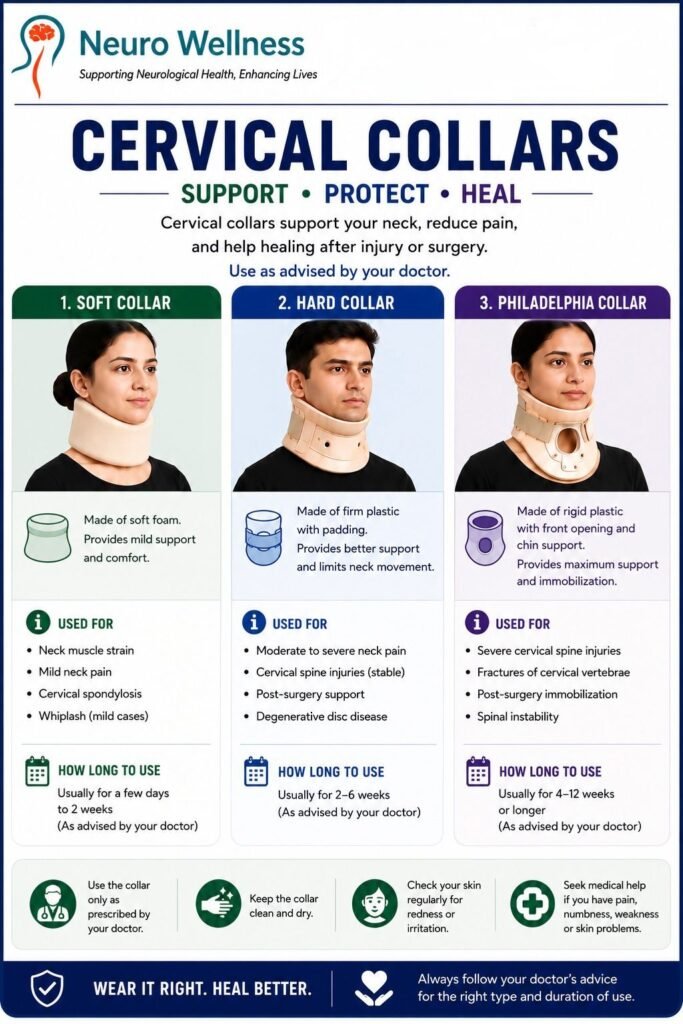
Cervical collar types: soft, hard and Philadelphia — complete guide
Cervical PIVD treatment in Bangalore: symptoms, non-surgical and surgical options
Exercises to relieve neck pain: 12 safe moves for after collar removal
Dr Ganesh Veerabhadraiah — Senior Neurosurgeon, NeuroWellness Jayanagar