
Stroke Emergency Guide
Recognise the signs. React in seconds. Act before minutes are lost.
If you suspect a stroke — don’t wait. Every minute of delay destroys brain cells that cannot be recovered.
30-Second Overview
What is a Stroke? The 30-Second Answer
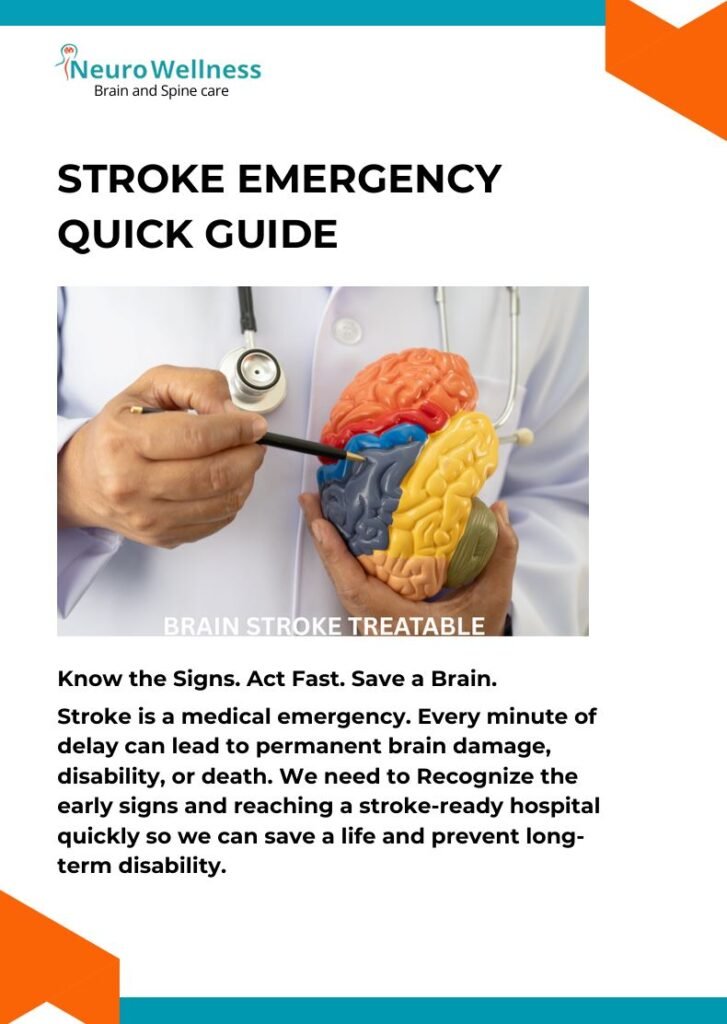
A stroke — also called a brain attack — occurs when blood flow to part of the brain is suddenly cut off. Without blood, brain cells begin to die within minutes. A stroke is a medical emergency. Unlike a heart attack, it is often silent and painless — the only warning signs are changes in face, arm, or speech.
There are two types: ischemic stroke (a clot blocks blood flow — 80–85% of strokes) and hemorrhagic stroke (a blood vessel ruptures). Both are emergencies requiring immediate hospital care.
The most important thing you can do right now is learn the FAST signs below and know your nearest stroke-ready hospital in Bengaluru.
Globally Recognised Method
The FAST Method – How to Recognise a Stroke Right Now
The FAST acronym is the globally recognised, medically validated method to identify stroke symptoms quickly. You do not need medical training to use it. Check all four signs in under 60 seconds.
⚠ If ANY FAST sign is present — call 108 and go to the nearest stroke-ready hospital NOW. Do not wait for symptoms to worsen.
F
FACE
Ask them to smile.
A
ARM
Ask them to raise both arms.
S
SPEECH
T
TIME
Note the exact time. Act now.
B
E
BE-FAST detects an additional 14% of strokes missed by the standard FAST method — particularly posterior circulation strokes that may not cause classic face, arm, or speech symptoms. Stroke symptoms appear suddenly and without warning. Even if they seem mild or come and go — seek emergency care immediately.
Critical Information for the Hospital Team
Note the Time of Onset – This Information Saves Lives
The treatments available to a stroke patient — and their chance of recovery — depend almost entirely on how much time has passed since symptoms began. The emergency team needs this the moment you arrive.
Exact Time Symptoms Started
If you witnessed the symptoms begin, record the precise time immediately. Write it on your phone or a piece of paper right now.
Last Time They Were Completely Normal
If the person was found unconscious or woke up with symptoms, tell the team the last time they were seen well. Example: “She was fine at 10pm. We found her like this at 6am.”
Thrombolysis (IV tPA)
Clot-dissolving injection for ischemic stroke. Most effective within the first 60 minutes.
Mechanical Thrombectomy
Catheter-based clot removal for large vessel occlusions. Standard eligibility window.
Extended Thrombectomy Window
In carefully selected patients where brain imaging shows viable tissue that can still be saved.
Remember: 1.9 million brain cells are lost every minute a stroke goes untreated. The faster you reach a stroke-ready hospital, the more brain can be saved.
In Order — Stay Calm
What to Do During a Stroke – Step by Step
Follow these steps in order. Stay calm. Every action below is designed to maximise the time available for treatment.
Check the FAST signs and confirm the emergency
Check face, arm, and speech. If any one sign is present — even mildly — proceed immediately. Do not wait for more symptoms to appear.
Note the exact time symptoms began
Write it down on your phone or a piece of paper right now. If unsure, write down the last time the person was completely normal. This is critical for treatment eligibility.
Call 108 (ambulance) immediately
Call the national ambulance service — 108 — immediately. Tell the operator you suspect a stroke. Provide the patient's location and the time symptoms began. The operator will guide you.
Keep the person safe, still, and calm
Help them sit or lie down safely. If conscious, position them on their side with head slightly raised in case of vomiting. Loosen any tight clothing around the neck. Keep them warm and still. Talk to them calmly.
Do not give food, water, or medication
Stroke can impair swallowing — even a sip of water can enter the lungs. Do not give any medication unless the emergency operator specifically instructs you to.
Go directly to a stroke-ready hospital
Proceed to a hospital that has CT scan availability, a stroke treatment team, and emergency capability. Do not stop at smaller clinics first — this loses precious time. See our verified list for Bengaluru below.
Patient Positioning
How to Position the Patient
If Conscious
Help them lie on their side (recovery position) with head gently elevated using a pillow or folded clothing. This prevents choking if they vomit. Keep them still and calm.
If Unconscious / Not Breathing
Begin CPR chest compressions immediately and do not stop until emergency services arrive. Call 108 while doing this. Do not leave the person alone.Avoid These Mistakes
What NOT to Do
In a stroke emergency, the wrong action can be as harmful as no action. These are the most common mistakes that delay treatment and worsen outcomes.
⏳
Wait to See If Symptoms Improve
Even TIA symptoms are an emergency. Every minute spent waiting means more brain cells are permanently lost.
🥤
Give Food, Water, or Medication
Stroke impairs swallowing without warning. Aspiration — fluid entering the lungs — is a serious, life-threatening complication.
😴
Let the Person Sleep It Off
This wastes the treatment window entirely and masks clinical deterioration that the hospital team needs to assess.
🌿
Try Home Remedies
No home remedy can dissolve a brain clot or stop a haemorrhage. Attempting them only loses time.
🏥
Stop at Multiple Clinics First
Go directly to a hospital with stroke treatment capability. Stopping at clinics without CT scan or neurologist on call wastes critical treatment time.
🙈
Dismiss Mild or Brief Symptoms
A TIA (mini-stroke) is the highest-risk warning sign for a major stroke. The risk is highest in the 24–48 hours after a TIA. Never ignore it.
Act Immediately
When to Shift to a Stroke-Ready Hospital in Bengaluru
Go to the nearest stroke-ready hospital without delay if any of the following occur. Do not wait for symptoms to persist or worsen.
Any FAST sign — face drooping, arm weakness, speech difficulty
Sudden confusion or difficulty understanding speech
Sudden weakness or numbness on one side of the body
Sudden severe headache — especially described as the worst ever
Sudden vision loss or blurring in one or both eyes
Sudden loss of balance, coordination, or ability to walk
Even if symptoms improve or disappear — seek emergency evaluation immediately. This could be a Transient Ischemic Attack (TIA). The risk of a full stroke is highest in the 24–48 hours after a TIA.
⚠ What is a TIA (Mini-Stroke)?
A Transient Ischemic Attack causes stroke-like symptoms that resolve within minutes to hours. Even though symptoms disappear, a TIA is a medical emergency.
The risk of a full stroke is highest in the 24–48 hours after a TIA. Urgent evaluation and treatment can prevent the major stroke that often follows.
🏥 What Is a Stroke-Ready Hospital?
- 24-hour CT scan — to confirm stroke type within minutes
- Emergency neurologist on call
- Thrombolysis (clot-dissolving IV medication) capability
- ICU or dedicated stroke unit for post-treatment monitoring
Save These Now
Emergency Contacts – Bengaluru
Save these numbers on your phone right now. Do not search for them during an emergency.
🧠
7259669911
Stroke referral coordination — South Bengaluru
🚑
108
Free emergency ambulance — Karnataka
💬
Triage Support
For referral coordination — not emergency response
📄 Download & Share This Emergency Guide
Save this guide as a PDF. Share it with your family, parents, and colleagues — before you ever need it. A few seconds now could save a life later.
No login required. Free for all Bengaluru families.
Quick Answers
Stroke Emergency FAQs – Bengaluru
Answers to the most common questions asked by families and bystanders — written for quick reading during or before an emergency.
FAST stands for: F — Face drooping (one side droops or is numb when asked to smile), A — Arm weakness (one arm drifts down when both are raised), S — Speech difficulty (slurred, confused, or unable to speak), T — Time to act immediately. Also watch for sudden balance loss (B) and sudden vision changes (E) — the BE-FAST method. If any sign appears, go to a stroke-ready hospital in Bengaluru immediately.
Do not wait for symptoms to improve. Do not give food, water, or medication. Do not let the person sleep it off. Do not attempt home remedies. Do not stop at multiple smaller clinics. Go directly to a stroke-ready hospital. Every minute of delay permanently destroys brain cells that cannot be recovered.
The time of onset determines which treatments are available. Thrombolysis (clot-dissolving injection) is given within 4.5 hours. Mechanical thrombectomy can be performed within 6–24 hours in selected patients. Even a 15-minute difference can change whether a patient qualifies for treatment. Note the exact time symptoms started — or the last time they were seen completely normal — and tell the emergency team immediately.
Go immediately if any FAST sign appears — face drooping, arm weakness, or speech difficulty. Also go for sudden severe headache, sudden vision loss, sudden confusion, or sudden weakness on one side. Even if symptoms resolve within minutes (possible TIA), seek emergency evaluation without delay. The risk of a full stroke is highest in the 48 hours after a TIA.
BE-FAST expands the FAST method by adding B — Balance (sudden loss of balance or coordination) and E — Eyes (sudden vision loss or blurring). These additions help identify strokes in the back of the brain (posterior circulation) which may not cause the classic face, arm, or speech symptoms. BE-FAST detects approximately 14% more strokes than FAST alone.
Call 108 — the free national ambulance service in Karnataka — immediately. You can also call 112 (national emergency number). Tell the operator you suspect a stroke and provide the patient’s symptoms, location, and the time symptoms began. If no ambulance is available, have someone drive directly to a stroke-ready hospital — the patient should not drive themselves.
If a 108 ambulance can reach you quickly, call it — the team can begin assessment en route and alert the hospital so the stroke team is ready on arrival. If an ambulance will take significantly longer, have someone else drive directly to the nearest stroke-ready hospital. The patient must not drive themselves. Do not stop at multiple clinics.
A TIA (Transient Ischemic Attack), or mini-stroke, causes stroke symptoms that resolve within minutes to a few hours. Even though symptoms disappear, a TIA is a medical emergency — the risk of a full stroke is highest in the 24–48 hours after a TIA. Do not dismiss symptoms that resolve on their own. Seek immediate neurological evaluation. Treatment after a TIA can prevent the major stroke that often follows.
If conscious, help them lie on their side (recovery position) with their head slightly raised and supported. This reduces the risk of choking if they vomit. Loosen any tight clothing around the neck. Keep them calm, still, and warm. Do not give food or water. If unconscious and not breathing, begin CPR and call 108 immediately.
Yes. Download the NeuroWellness Stroke Emergency Guide PDF for free using the button on this page. Save it on your phone and share it on WhatsApp with your family. Having it ready before an emergency means no time is lost searching for information in a crisis. The PDF includes FAST signs, emergency contacts, and what NOT to do.
Stroke Network
Explore the Stroke Network
Everything you need — from emergency guidance to hospital listings and patient referral — is structured and accessible here.
Important Disclaimer: This website is not a 24/7 monitored emergency response service. In case of a suspected stroke, proceed immediately to the nearest stroke-ready hospital or call 108. Do not wait for an online or WhatsApp response. The information on this page is for educational and general guidance purposes only — it does not constitute medical advice. Always seek immediate in-person medical care during a stroke emergency.
Page last reviewed: January 2026 | Medically reviewed by Dr. Ganesh Veerabhadraiah, Consultant Neurosurgeon & Neurointerventional Surgeon, NeuroWellness Bengaluru. Next review due: April 2026.