
NeuroWellness · Spine Surgery Guide, Bengaluru
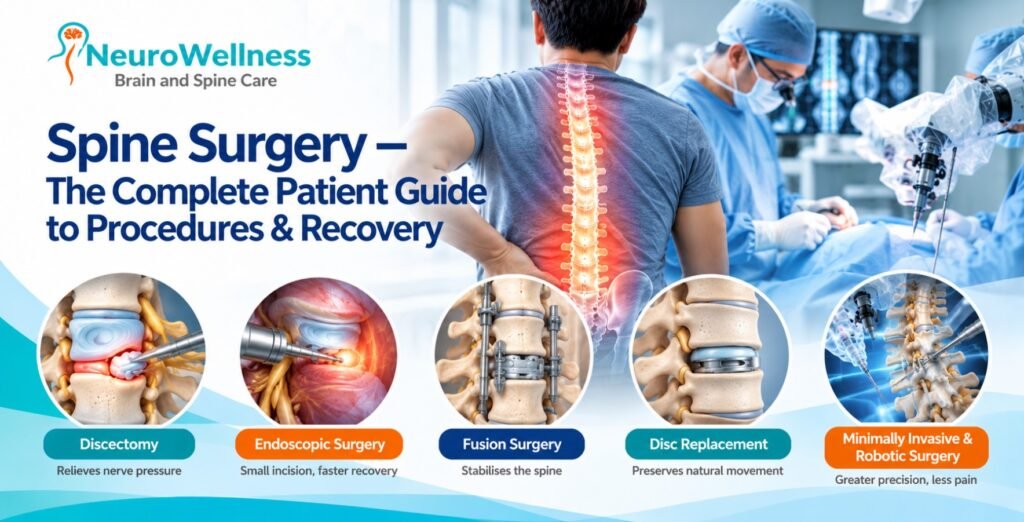
Spine Surgery - The Complete Patient Guide to Procedures & Recovery
Surgery-last
Most spine problems are treated without surgery first
Keyhole
Endoscopic & MIS options — often day-care or short stay
20+ yrs
Neurosurgical experience in complex brain & spine cases
Do You Actually Need Spine Surgery?
For most people, no. The majority of back pain, neck pain and sciatica improve with physiotherapy, medication and time. Spine surgery is considered only when non-surgical treatment has failed, or when there are clear signs of nerve or spinal-cord compression. A good spine surgeon will always explain the non-surgical route first — see the full non-surgical treatment guide →
🧭 Surgery-last philosophy
Non-surgical options are always explained and tried first.
🔬 Minimally invasive first
Keyhole, endoscopic and robotic techniques where appropriate.
📋 17 procedures explained
From microdiscectomy to complex deformity correction.
💬 Second opinions welcome
Already advised surgery elsewhere? Get an independent view.
✅ Surgery is usually considered when…
• Leg or arm pain persists despite 6–12 weeks of proper conservative care
• There is progressive weakness, numbness or foot drop
• Imaging shows clear nerve or spinal-cord compression matching your symptoms
• Spinal instability, deformity or fracture needs stabilising
• Red-flag signs (bladder/bowel changes, saddle numbness) – this is urgent
🛑 Surgery is usually NOT the first step when…
• Pain is recent (a few days to weeks) and improving
• There is no nerve weakness or red-flag symptom
• An MRI shows age-related changes but they don’t match your symptoms
• Physiotherapy and activity haven’t been given a fair trial yet
• The only goal is generalised back pain relief without a clear target
What’s the Difference?
Minimally Invasive, Endoscopic & Robotic Spine Surgery
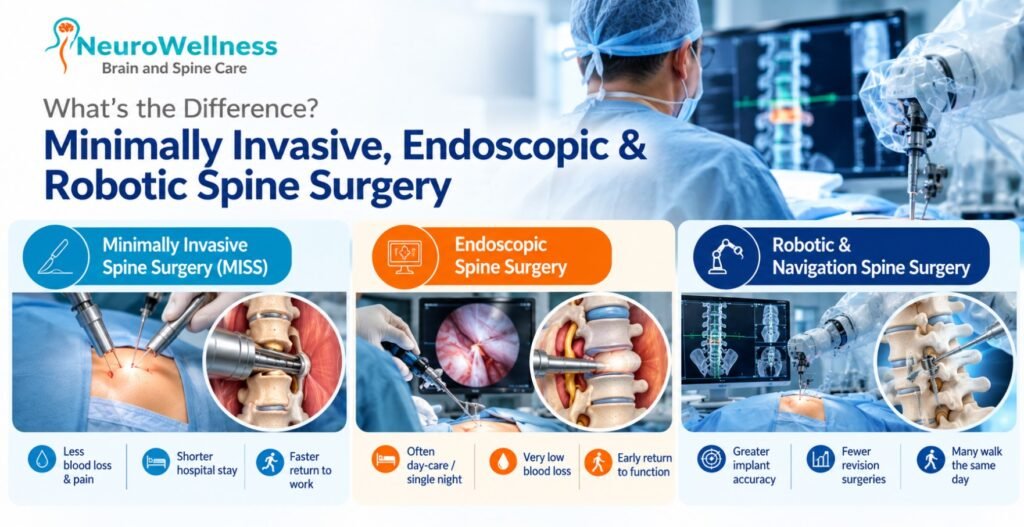
Modern spine surgery has moved away from large open incisions. Most procedures today use small incisions that preserve muscle, meaning less pain, less blood loss and faster recovery. Which technique suits you depends on your conditio, not every case needs the newest technology.
SPARING Minimally Invasive (MISS)
Small incisions and tubular retractors preserve surrounding muscle.
• Less blood loss & pain
• Shorter hospital stay
• Faster return to work
Endoscopic Spine Surgery
An HD scope through an incision often under 1 cm treats discs and nerve compression.
• Often day-care / single night
• Very low blood loss
• Early return to function
Robotic & Navigation
A 3D plan guides millimetre-accurate implant placement. The robot assists — it does not operate on its own.
• Greater implant accuracy
• Fewer revision surgeries
• Many walk the same day
Every Procedure, One Table
Spine Procedures & Surgeries We Perform
From the most common to the most complex what each procedure treats and how it’s approached.
| Category | Procedure | Used for | Approach |
|---|---|---|---|
| Decompression | Microdiscectomy (MLD) | Sciatica from a herniated lumbar disc | Minimally invasive, muscle-sparing |
| Decompression | Endoscopic Discectomy | Disc herniation & nerve compression | Keyhole (<1cm incision), day-care |
| Decompression | Laminectomy / Laminoplasty | Spinal canal stenosis | Posterior decompression |
| Decompression | Foraminotomy | Pinched nerve at the exit canal | Targeted, muscle-sparing |
| Cervical (Neck) | ACDF | Cervical disc disease, nerve/cord compression | Front-of-neck |
| Cervical (Neck) | Cervical Disc Replacement | Cervical disc disease — motion-preserving alternative to ACDF | Front-of-neck, artificial disc |
| Fusion & Stabilisation | TLIF | Lumbar instability, spondylolisthesis | Posterior, one-sided |
| Fusion & Stabilisation | PLIF | Lumbar instability, disc collapse | Posterior, two-sided |
| Fusion & Stabilisation | ALIF | Lumbar instability, disc collapse | Front-of-abdomen |
| Fusion & Stabilisation | XLIF | Lumbar instability, adjacent segment disease | Lateral (side/flank) |
| Fusion & Stabilisation | Spinal Fixation & Instrumentation | Stabilisation after trauma, deformity or tumour surgery | Screws, rods, plates |
| Fracture & Bone | Vertebroplasty / Kyphoplasty | Osteoporotic compression fractures | Cement stabilisation, minimally invasive |
| Complex & Deformity | Corpectomy | Tumour, severe fracture or multi-level cervical disease | Vertebral body removal & reconstruction |
| Complex & Deformity | Scoliosis / Deformity Correction | Abnormal spinal curvature | Instrumented correction, multi-level |
| Complex & Deformity | Spinal Tumour Surgery | Primary or metastatic spinal tumours | Ranges from minimally invasive biopsy to complex resection |
| Complex & Deformity | Spine Trauma Surgery | Fracture or spinal cord injury | Stabilisation and/or decompression |
| Precision Layer | Robotic-Assisted & Navigation-Guided Surgery | Applied across fusion & fixation procedures above | 3D-planned, millimetre-accurate screw placement |
The Most Common Spine Surgeries
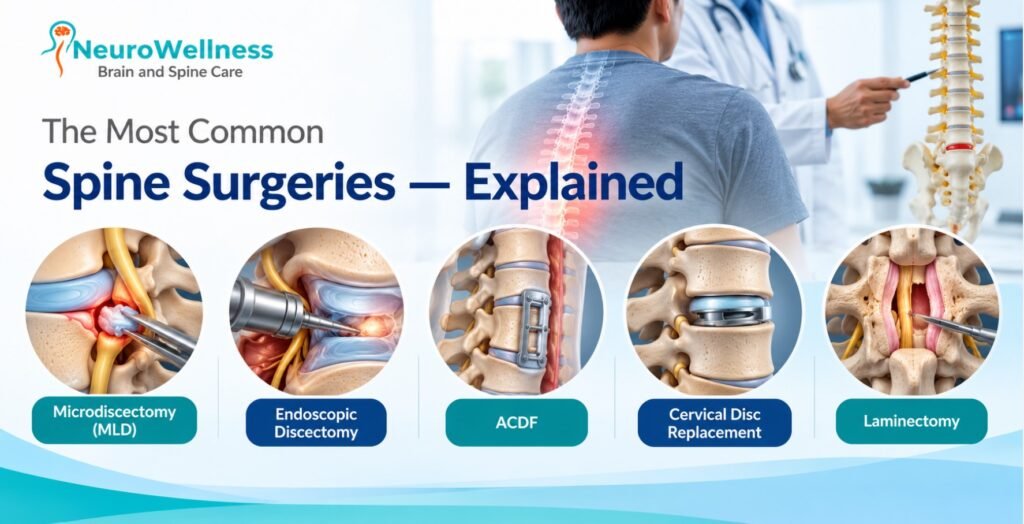
The procedures most patients are researching when a surgeon first mentions surgery.
Microdiscectomy (MLD)
One of the most frequently performed and successful spine surgeries — the standard treatment for sciatica from a lumbar disc herniation that hasn’t responded to conservative care. A small portion of the disc pressing on the nerve is removed. Many patients walk the same day.
Cervical Disc Replacement
A motion-preserving alternative to ACDF in select patients — the worn disc is replaced with an artificial one instead of fusing the level, keeping more natural neck movement.
Laminectomy
Removal of part of the vertebral bone (lamina) to relieve pressure on the spinal canal — the standard operation for spinal canal stenosis causing leg pain on walking.
Lumbar Fusion, Explained Level by Level
TLIF, PLIF, ALIF and XLIF all achieve the same goal — joining two vertebrae to stop painful movement — but differ in the direction of approach. Each has particular strengths depending on the patient’s anatomy and the level involved.
TLIF
Transforaminal Lumbar Interbody Fusion. Approached from one side through the natural nerve exit tunnel — less nerve retraction than PLIF, which is why it’s now more widely used.
PLIF
Posterior Lumbar Interbody Fusion. Approached directly from the back on both sides of the spinal canal — historically the more common technique, requiring slightly more nerve retraction.
ALIF
Anterior Lumbar Interbody Fusion. Approached through a small lower-abdomen incision, avoiding the back muscles and nerves entirely, allowing a larger implant. Often performed jointly with a vascular access surgeon.
XLIF
Extreme/Lateral Lumbar Interbody Fusion. Approached from the patient’s side through the psoas muscle with continuous nerve monitoring. Temporary thigh numbness is possible and usually settles over weeks.
Less Common — Rare
Complex & Less Common Procedures
Less frequently needed, but important to understand if your surgeon has recommended one of these.
Vertebroplasty / Kyphoplasty
Cement is injected into a collapsed, osteoporotic vertebra to stabilise it and relieve pain — kyphoplasty adds a balloon step to help restore height first.
Corpectomy
Removal of a vertebral body, usually for tumours, severe fractures, or multi-level cervical disease, followed by reconstruction with a cage or graft.
Scoliosis / Deformity Correction
Instrumented correction of an abnormal spinal curve, using screws and rods across multiple levels — most often for adolescent scoliosis or adult degenerative curves.
Spinal Tumour Surgery
Ranges from minimally invasive biopsy to complex resection of primary or metastatic tumours, often planned jointly with oncology.
Spine Trauma Surgery
Stabilisation and/or decompression after a fracture or spinal cord injury — urgency and approach depend on stability and neurological status.
How Long Is Recovery?
Recovery Timeline
It depends on the procedure. After microdiscectomy or endoscopic surgery, many patients walk the same or next day and return to desk work in 2–4 weeks. Fusion recovery is longer — most daily activities return over 6–12 weeks, with improvement continuing for months. See our approach to rehabilitation →
First Steps
Fusion consolidates; return to heavier activity and sport as advised.
WEEK 1–2
Wound Healing
Wound heals; short walks increase daily; light home activity resumes.
WEEK 2–6
Back to Desk
Desk work often resumes after keyhole/disc surgery; guided physiotherapy begins.
WEEK 6–12
Most Activities
Most normal activities return, including after fusion; strengthening continues.
3–6 MONTHS
Full Recovery
Fusion consolidates; return to heavier activity and sport as advised.
Prepare for Your Consultation
Questions worth asking your spine surgeon
❓ Why this procedure?
What specifically in my history, exam and scans points to this operation over alternatives?
🔁 What if I wait or don't operate?
What's the realistic outlook with continued conservative care instead of surgery?
📊 What's your experience with this exact surgery?
How many have you performed, and what's the typical outcome and complication rate?
⏱️ What does recovery really look like?
Realistic timelines for walking, driving, work and full recovery not just best-case figures.
Is Spine Surgery Safe?
Modern spine surgery is very safe in experienced hands. Minimally invasive and endoscopic techniques reduce blood loss, infection risk and recovery time. Every operation carries some risk — the key is careful patient selection, precise imaging-guided planning, and choosing the right procedure for the right person.
🎯 Right diagnosis
Surgery is planned only when imaging clearly matches your symptoms
🔬 Precise technique
Muscle-sparing, magnified and navigation-guided approaches
🧠 Nerve monitoring
Intra-operative monitoring protects the spinal cord and nerves.
🏥 Neuro-ICU backup
Expert post-op care for complex cases when needed.
Common Questions
Spine Surgery - Frequently Asked Questions
Modern spine surgery is very safe when performed by an experienced spine surgeon. Minimally invasive and endoscopic techniques further reduce blood loss, infection risk and recovery time. Every procedure carries some risk, which is minimised through careful patient selection, imaging-guided planning and, where useful, navigation or robotic assistance.
Recovery depends on the procedure. After microdiscectomy or endoscopic surgery, many patients walk the same or next day and return to desk work in 2–4 weeks. Fusion recovery is longer — typically 6–12 weeks for most daily activities, with continued improvement over months.
Look for a surgeon with fellowship training in minimally invasive, endoscopic and navigation-assisted techniques, who explains non-surgical options first and discusses risks transparently. The right choice is the one whose experience matches your specific condition.
Both perform spine surgery. A neurosurgeon’s training is particularly valuable when the spinal cord or nerves are involved — as in disc herniation, stenosis, tumours or cord compression.
For well-selected patients, procedures like microdiscectomy for sciatica have high success rates in relieving leg pain. Success depends heavily on correct diagnosis and choosing the right procedure for the right patient — which is why non-surgical options are always considered first.
Often, yes. Most back pain and many disc problems improve with physiotherapy, medication and posture correction. If you’ve been advised to operate and are unsure, a second opinion can confirm whether surgery is truly needed.
Ask why this specific procedure is recommended for your case, what happens if you wait or continue non-surgical care, the surgeon’s experience with that exact operation, and a realistic — not best-case — recovery timeline. A good surgeon welcomes these questions.
Explore Further
The NeuroWellness Spine Network
Everything you need — from understanding your condition to weighing surgical and non-surgical options.
Spine Care Hub
The complete spine care pillar — conditions, symptoms, treatments, surgery, prevention & recovery in one place.
Spine Conditions & Disorders
Understand what's actually causing your pain before deciding on treatment.
Spine Investigations
What X-ray, MRI, CT and nerve tests show — and when each is actually needed.
Non-Surgical Spine Treatments
Physiotherapy, injections and conservative care — the first step for most patients.
Second Opinion
Already been advised to have surgery? Get an independent, honest assessment first.
Spine Blogs
Ongoing articles on specific conditions, recovery stories and the latest in spine care.
Talk to a spine surgeon in Bengaluru
Whether you need surgery, a second opinion, or simply a clear explanation of your MRI — get honest, specialist advice on your options.
Medically reviewed by Dr. Ganesh Veerabhadraiah, HOD and Senior Consultant Neurosurgeon, NeuroWellness, Bengaluru. Last reviewed: 20-Oct-2026
Disclaimer: This content is for educational purposes only and is not a substitute for professional medical advice, diagnosis or treatment. Please consult a qualified specialist for guidance appropriate to your condition. Do not use this information for self-diagnosis or self-treatment. In a medical emergency, seek immediate care at the nearest hospital. NeuroWellness does not promote, endorse or recommend any particular doctor or procedure.