NEUROWELLNESS · SPINE CARE, BENGALURU
Spine Surgery Recovery & Rehabilitation
How long does recovery really take? Here are honest, procedure-by-procedure timelines, a week-by-week roadmap, clear do’s and don’ts, and how physiotherapy gets you back to life safely.
24 hrs
Most walk within a day of minimally invasive surgery
2–4 wks
Desk work after microdiscectomy
8–12 wks
Office work after spinal fusion
3–6 mo
Bone fusion becomes solid
How long does spine surgery recovery take?
Only a handful of symptoms need same-day emergency care — know them.
It depends heavily on the procedure. Minimally invasive disc surgery (like microdiscectomy) allows a return to desk work in about 2–4 weeks, while spinal fusion takes longer — typically 8–12 weeks for office work, with bone healing over 3–6 months. Recovery is always individualised by your surgeon, and structured rehabilitation makes it faster and safer.
This page gives realistic timelines by procedure, then walks you through exactly what to expect and do at each stage.
⏱️ Recovery is procedure-specific
Local ache, radiating pain and nerve symptoms each point to different causes.
🚶 Movement heals
The large majority of spine symptoms improve with simple, conservative care.
📋 Rehab isn't optional
One-limb vs both-limb, and pain vs numbness, both change the likely cause.
⚠️ Know the warning signs
A short, clear list tells you when to call rather than wait.
Recovery timelines by procedure
Typical, indicative ranges for otherwise healthy adults. Your surgeon will tailor these to you, the number of levels, and your job.
| Procedure | Hospital stay | Walking | Desk work | Physio starts | Fuller recovery |
|---|---|---|---|---|---|
| Microdiscectomy | Day-care / 1 day | Same day | 2–4 weeks | 2–4 weeks | ~6–12 weeks |
| Endoscopic discectomy | Day-care | Same day | 2–3 weeks | 2–4 weeks | ~6 weeks |
| Laminectomy / decompression | 1–2 days | Day 1 | 2–6 weeks | 3–4 weeks | ~6–12 weeks |
| ACDF (cervical) | Day-care / 1 day | Day 1 | 2–4 weeks | 4–6 weeks | Fusion 3–6 months |
| Lumbar fusion (TLIF/PLIF) | 2–4 days | Day 1–2 | 8–12 weeks | 6+ weeks | Fusion 3–6 months |
Physically demanding jobs typically need longer (often 8–12 weeks+) and medical clearance. Never drive while taking prescription pain medication.
What to Expect
Your week-by-week recovery roadmap
A general guide for minimally invasive / disc surgery. Fusion recovery follows the same shape over a longer window.
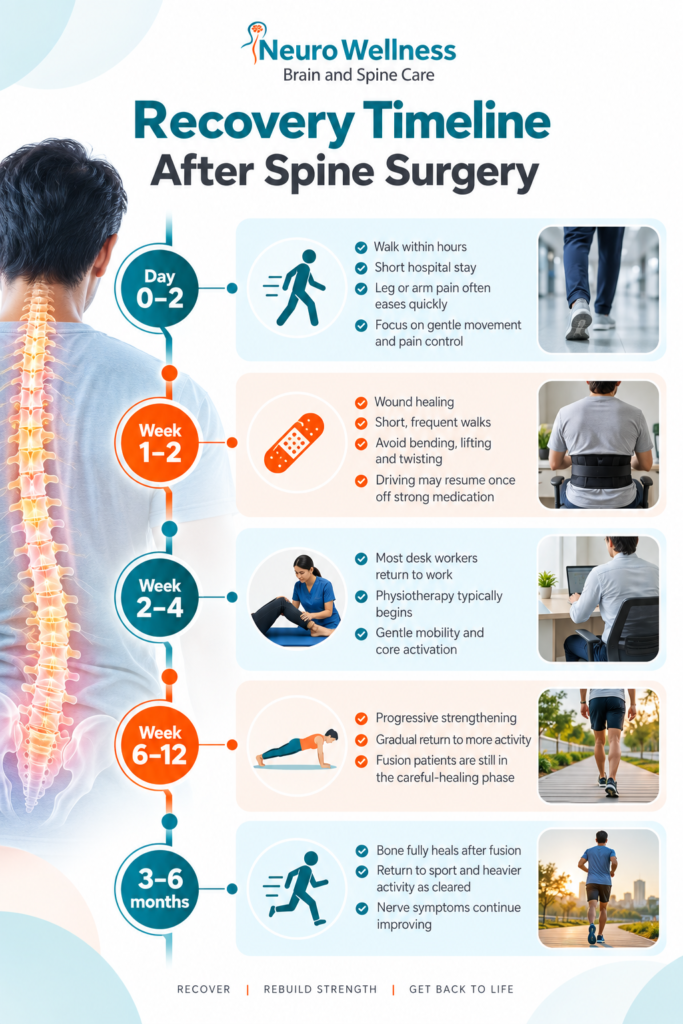
Day 0–2
Walk within hours; short hospital stay. Leg or arm pain often eases quickly. Focus on gentle movement and pain control.
Week 1–2
Wound healing; short, frequent walks. Avoid bending, lifting and twisting. Driving may resume once off strong medication.
Week 2–4
Most desk workers return to work. Physiotherapy typically begins — gentle mobility and core activation.
Week 6–12
Progressive strengthening. Gradual return to more activity; fusion patients are still in the careful-healing phase.
3–6 months
Bone fully heals after fusion. Return to sport and heavier activity as cleared. Nerve symptoms continue improving.
Protect Your Healing Spine
Do's & don'ts after spine surgery
For the first several weeks, avoid Bending, heavy Lifting and Twisting — the three movements most likely to stress a healing spine.
✅ Do
- Walk little and often — it’s the best early exercise
- Follow wound-care and medication instructions
- Change position regularly; use good posture
- Start physiotherapy when advised
- Sleep well and eat a balanced, protein-rich diet
- Attend follow-up appointments
⛔ Don't
- Bend, twist, or lift more than advised (usually ~5 kg)
- Sit or stay in one position for too long
- Drive while on prescription pain medication
- Rush back to the gym or heavy work
- Smoke — it slows bone and wound healing
- Ignore new warning signs (see below)
Getting Back to Normal
When can I return to…?
💻 Desk work
2–4 weeks Longer for fusion / physical jobs
🏋️ Gym / heavy lifting
6–12 weeks+ Gradual, with clearance
🏃 Sport / high-impact
~3 months Low-impact first (walk, swim)
✈️ Air travel
2–6 weeks Move often on long flights
🔨 Physical labour
8–12 weeks+ Only with medical clearance
These are general guides your surgeon’s advice for your specific procedure always takes priority.
Return to sport, activity by activity Activity
| Activity | Typical timeline | Notes |
|---|---|---|
| Walking | Day 0 onward | The best early activity — start gentle, build gradually |
| Swimming | ~4–6 weeks | Once the wound is fully healed; low-impact on the spine |
| Cycling (stationary) | ~4–6 weeks | Upright posture preferred over an aggressive forward lean |
| Yoga / Pilates | ~6–8 weeks | Gentle, guided sessions; avoid deep twists/backbends early on |
| Running | ~8–12 weeks | Build up gradually; stop if pain returns |
| Golf / racquet sports | ~3 months | Rotational sports need full core recovery first |
| Contact sports | 3–6 months, case-by-case | Needs explicit surgeon clearance |
The Engine of Recovery
Physiotherapy & rehabilitation phases
Structured rehab is what turns a good operation into a good outcome restoring movement, rebuilding strength, and preventing recurrence. It usually progresses in phases.
Protect & move
Gentle walking, pain control, wound healing.
Physiotherapy
Guided stretches, posture, gentle core activation.
Strengthen
Progressive core and back strengthening.
Return to activity
Work, sport and lifestyle, plus prevention.
Looking for “physiotherapy near me” in Bengaluru? We coordinate rehabilitation at both our locations. Ask us →
Not Had Surgery?
Recovering from back pain or sciatica without surgery
Stay active
Gentle movement and short walks beat prolonged bed rest, which can slow recovery.
Physiotherapy
Guided exercise is the cornerstone — most disc and sciatica pain settles in 6–12 weeks.
Build habits
Posture, core strength and ergonomics keep the pain from coming back.
Return to activity
Work, sport and lifestyle, plus prevention.
Often Overlooked
Nutrition, sleep & healing — the quiet contributors
Surgery and physiotherapy do the heavy lifting, but daily habits meaningfully affect how well and how fast you heal.
🍽️ Protein & nutrition
Adequate protein, vitamin D and calcium support wound and bone healing, especially after fusion. Stay well hydrated and keep meals balanced.
🛌 Sleep position
Sleeping on your back with a pillow under the knees, or on your side with a pillow between the knees, keeps the spine neutral and reduces morning stiffness.
🚭 Avoid smoking & alcohol
Smoking significantly slows bone fusion and wound healing; alcohol can interact with pain medication. Both are worth pausing during recovery.
General guidance only your surgeon or dietitian can tailor advice if you have diabetes, osteoporosis or other conditions affecting healing.
Warning Signs
When to call your surgeon during recovery
Contact us promptly if you notice:
- Fever, or increasing redness, swelling or discharge from the wound (possible infection)
- New or worsening weakness, numbness, or leg/arm pain
- Loss of bladder or bowel control (seek emergency care)
- Severe pain not controlled by your prescribed medication
- Calf pain/swelling or breathlessness (possible clot — urgent)
Call us: Jayanagar +91 7259 669 911 · Electronic City +91 7411 571 002
Why NeuroWellness
Recovery is guided, not guessed
📋 Structured rehab plans
A clear, procedure-specific recovery plan — you always know what's next.
🤝 Close follow-up
Regular reviews to track healing and adjust your plan safely.
📍 In Bengaluru
Rehabilitation coordinated at Jayanagar and Electronic City.
COMMON QUESTIONS
Spine Recovery FAQs
It depends on the procedure. Minimally invasive disc surgery like microdiscectomy allows a return to desk work in about 2–4 weeks, while spinal fusion recovery is longer — typically 8–12 weeks for office work, with bone healing over 3–6 months. Your surgeon individualises the timeline to you.
Microdiscectomy is usually a day-care procedure. Most people walk within hours, drive at 1–2 weeks, and return to desk work in 2–4 weeks. Avoid heavy lifting, bending and twisting for the first several weeks; physiotherapy usually begins around 2–4 weeks.
After ACDF, most patients rest for 1–2 weeks, resume driving and light desk work around 2–4 weeks, and start physiotherapy at 4–6 weeks. Bone fusion becomes solid over 3–6 months, and nerve healing can continue for up to 12 months.
Typically around 1–2 weeks after minimally invasive disc surgery and about 2 weeks after single-level ACDF — but only once you’re off prescription pain medication and can move comfortably. Always get your surgeon’s clearance first.
For the first several weeks, avoid bending, heavy lifting and twisting (the “BLT” rule), prolonged sitting, and strenuous activity. Do walk regularly, follow wound-care advice, and never drive while on strong pain medication.
Yes. Adequate protein, vitamin D and calcium support wound and bone healing, especially after fusion. Smoking significantly slows bone fusion and wound healing, and alcohol can interact with pain medication — both are worth avoiding during recovery.
Planning surgery, or recovering now?
Get a clear, realistic recovery plan tailored to your procedure and the follow-up support to get you safely back to life.
Medical Review and Disclaimer :
This page has been medically reviewed by Dr. Ganesh Veerabhadraiah, Head of the Department and Senior Consultant Neurosurgeon – Brain, Spine and Endovascular Surgery.
The information provided is intended solely for general education and awareness. It should not be used for self-diagnosis, self-medication or as a substitute for professional medical consultation, diagnosis or treatment.
NeuroWellness does not endorse or recommend any particular doctor, hospital, treatment or procedure. Patients should consult an appropriately qualified medical specialist for personalised evaluation and guidance.
In a medical emergency, please seek immediate assistance at the nearest hospital or emergency department.