NeuroWellness · Spine Conditions Guide, Bengaluru
Spine Conditions & Disorders -The Complete Patient Guide
From everyday backache and sciatica to spondylosis, stenosis and rarer spine disorders – clear, neurosurgeon-reviewed explanations of what each condition actually is, what causes it, and what it means for you. Written for anyone aged 20 to 70, and for the GPs and physiotherapists who see them first.
#1
~60–66%
Most
Under 40
What are spine conditions?
Spine conditions are any problems affecting the vertebrae, discs, joints, nerves or spinal cord — causing back pain, neck pain, or symptoms that radiate into the arms or legs. They range from very common, self-limiting issues like a disc bulge or muscle strain, to conditions that need specialist care such as stenosis, deformity, tumours or infection. This guide groups them the way patients actually experience them — by where they occur and what they affect — with a tag for whether surgery is usually needed. The good news: most are not serious, and most improve without surgery.
NAVIGATE BY LOCATION
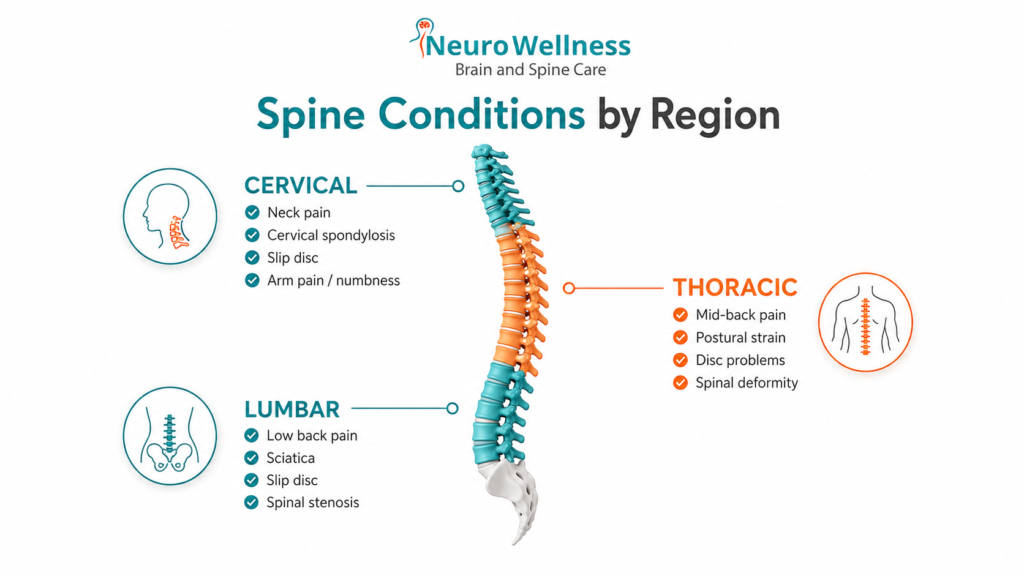
Where is your pain?
Spine conditions often cluster by region. Start with where you feel it.
Neck (Cervical)
Neck pain, pain or tingling into the arm/hand, stiffness, headaches.
Mid-Back (Thoracic)
Less common; mid-back pain, band-like pain, or pain from posture/fractures.
Lower Back (Lumbar)
The most common region — low back pain, sciatica down the leg, numbness.
Whole-Spine / Multiple Levels
Not limited to one region — curvature, inflammatory or infective conditions.
The most common cause of all: ordinary muscular back pain
Before disc problems or spondylosis, the single most common cause of back pain is simple mechanical (non-specific) back pain — a muscle or ligament strain from a bad lift, a long drive, or an awkward sleeping position, with no nerve involvement. It usually settles within days to a few weeks with gentle movement, heat and simple pain relief, and rarely needs any scan at all.
Clearing the Confusion
Slipped Disc, Herniated Disc, Disc Bulge, PIVD - What's the Difference?
These terms mostly describe the same family of problem. A disc doesn’t actually “slip”. “Slipped disc”, “herniated disc”, “prolapsed disc” and “ruptured disc” are different names for a disc whose soft inner core pushes through its tougher outer wall. In India, you’ll often see PIVD (Prolapsed Intervertebral Disc) on MRI reports — a broader term covering bulges, protrusions and herniations. Severity depends less on the label and more on whether the disc is pressing on a nerve.
Disc Bulge
Outer wall intact but stretched. Very common; often painless.
Protrusion
Inner core starts pushing through a tear but stays attached.
Herniation / Extrusion
Inner material breaks through the outer wall — more likely to press a nerve.
Sequestration
A fragment separates. May cause significant nerve symptoms.
Common
Disc & Nerve Conditions
Slipped / Herniated Disc (PIVD)
The most common disc problem. A disc presses on a nearby nerve, causing back/neck pain that can radiate to a limb.
Sciatica
Not a disease itself but a symptom — pain travelling from the lower back down the leg along the sciatic nerve, usually from a lumbar disc.
Pinched Nerve (Radiculopathy)
Any nerve root compressed as it exits the spine, in the neck or lower back.
Cervical Disc Prolapse
A herniated disc in the neck that can press a nerve root or the spinal cord.
Common – Age-Related
Degenerative & Age-Related Conditions
Natural “wear and tear” of the spine over time. Very common — and usually manageable.
Cervical Spondylosis
Age-related wear of the neck discs and joints. Common after 40 and often symptom-free.
Watch for: neck stiffness, headaches; see a specialist if arms/hands are affected.
Lumbar Spondylosis
Degenerative change in the lower back — discs, joints and ligaments.
Watch for: chronic low back pain, stiffness, worse with activity.
Degenerative Disc Disease
Discs gradually lose height and hydration with age — a normal process that is only "disease" when it causes pain or instability.
Watch for: stiffness that eases with movement, pain worse after prolonged sitting.
Spinal Canal Stenosis
The canal narrows and presses on nerves — common in older adults.
Watch for: leg pain/heaviness when walking that eases when you sit or bend forward.
Spondylolisthesis
One vertebra slips forward over the one below, causing instability.
Watch for: back pain, leg pain, worse with standing/walking.
Osteoporotic Compression Fracture
Weakened, porous bone (osteoporosis) causes a vertebra to gradually collapse or fracture — often with minimal or no trauma, more common in post-menopausal women and older adults.
Watch for: sudden-onset back pain, height loss, or a stooped posture over time; a DEXA scan assesses bone density risk.
Less Common
Deformity, Inflammatory & Congenital Conditions
Less common than disc or degenerative problems, but important to recognise — several run in families or begin early in life.
Scoliosis
An abnormal sideways curve, often appearing in adolescence or from degeneration in adults.
Watch for: uneven shoulders/hips, visible curve, back pain in adults.
Kyphosis
Excess forward curvature of the upper back — postural, age-related or from fractures.
Ankylosing Spondylitis
An inflammatory arthritis that mainly affects the spine, causing pain and progressive stiffness — part of a wider group of inflammatory spondyloarthritis.
Congenital Spine Conditions
Spina bifida and tethered cord syndrome spine or spinal cord differences present from birth, ranging from mild to significant.
Watch for: a birthmark or dimple over the lower spine in infants; delayed milestones or new bladder symptoms in children.
Rare – Needs Prompt Assessment
Serious & Urgent Conditions
Less common, but important to recognise early. These need prompt specialist assessment.
Cauda Equina Syndrome
A large disc or mass compresses the bundle of nerves at the base of the spine. A surgical emergency.
Red flags: loss of bladder/bowel control, saddle numbness, both-leg weakness.
Spinal Cord Compression
Pressure on the spinal cord itself, from disc, stenosis, tumour or trauma.
Red flags: hand clumsiness, unsteady walking, progressive weakness.
Spine Infection / TB Spine
Infection of the vertebrae or disc. Tuberculosis of the spine remains relevant in India and is very treatable when caught early.
Watch for: persistent back pain with fever, night sweats or weight loss.
Spinal Tumours
Growths in or around the spine. Early diagnosis matters greatly for outcomes.
Watch for: constant pain worse at night, unexplained weight loss, weakness.
Osteoporotic Compression Fracture
A weakened (osteoporotic) vertebra collapses — often in older adults, sometimes with minimal injury.
Watch for: sudden back pain, loss of height, stooped posture.
Spinal Trauma & CV Junction Disorders
Injury or instability of the spine, including the complex junction where the skull meets the spine.
Watch for: severe pain after injury, neurological symptoms.
Why NeuroWellness
An Accurate Diagnosis Is Everything
Accurate diagnosis is what separates a spine problem that resolves with physiotherapy from one that genuinely needs surgery. A typical evaluation goes: clinical examination → imaging where needed → specialised tests where indicated → a diagnosis and plan tailored to the patient, not the scan.
Clinical Exam
Strength, sensation, reflexes, gait — often narrows the cause before any scan.
X-ray
Bone alignment, stability and degenerative change. Quick and widely available.
MRI Spine
The gold standard for discs, nerves, the spinal cord and soft tissue. No radiation.
CT Scan
Best for detailed bone anatomy, fractures and surgical planning.
EMG / NCV
Confirms and localises nerve root or peripheral nerve involvement.
Bone density (DEXA) scans and selective blood tests are used to assess osteoporosis risk or rule out infection and inflammatory disease. An MRI is generally reserved for pain that persists beyond a few weeks, neurological symptoms, or red flags — not every ordinary backache. See the full guide to spine investigations →
WHY THEY HAPPEN
Common causes & risk factors
A Common Question
Should I see my GP or a spine specialist first?
Either is a reasonable starting point here’s how to decide.
👨⚕️
Start with your GP if
Symptoms are new, mild-to-moderate, and there are no red flags. A GP can guide initial care and refer onward if needed.
🧠
See a spine specialist if
Pain radiates into an arm or leg, persists beyond ~6 weeks, or comes with numbness, tingling or weakness.
🚨
Skip straight to emergency care if
You have loss of bladder/bowel control, saddle numbness, or rapidly worsening weakness — these need same-day assessment.
Setting the Record Straight
Myths vs Facts About Spine Problems
Patient anxiety around spine problems often comes from a handful of persistent myths. Here’s what the evidence actually shows.
| Myth | Fact |
|---|---|
| Any back pain means I need surgery | Around 90% of back and disc-related pain improves without surgery within 6–12 weeks of conservative care. |
| I need an MRI for every backache | Most back pain is diagnosed on history and examination alone; MRI is reserved for persistent pain, red flags, or neurological symptoms. |
| Bed rest is the best treatment | Staying gently active usually speeds recovery — prolonged bed rest can slow it and weaken supporting muscles. |
| A “slipped disc” means the disc has moved out of place | Discs don’t slip — the soft inner core bulges or herniates through the tougher outer wall, but the disc stays anchored between the vertebrae. |
| Back pain in your 20s and 30s is unusual | Disc and posture-related back pain is increasingly common in desk-bound adults under 40. |
| An MRI showing “wear and tear” means something is seriously wrong | Degenerative changes on MRI are extremely common after age 30–40, even in people with no pain at all — findings are interpreted alongside your symptoms, not in isolation. |
WHY NEUROWELLNESS
An accurate diagnosis is everything
🧠 Neurosurgeon-led
When nerves or the spinal cord are involved, a neurosurgeon's assessment is invaluable.
🧭 Surgery only when needed
We identify the many conditions that don't need surgery — and treat conservatively first.
📍 In Bengaluru
In-person and online consultations, with second opinions available.
COMMON QUESTIONS
Spine Conditions FAQs
They describe the same family of problems. “Slipped disc” is informal — the disc doesn’t actually slip. A disc bulge is the mildest form (the outer wall stays intact); a herniated disc is when the inner material pushes through a tear in the outer wall. PIVD (Prolapsed Intervertebral Disc) is the broader Indian radiology term covering all of these.
Yes. Most disc herniations improve within 6–12 weeks with staying active, anti-inflammatory medication and physiotherapy. Surgery is reserved for severe or persistent nerve pain, or weakness that doesn’t improve.
Mechanical low back pain and degenerative disc disease are the most common, followed by sciatica, cervical spondylosis and lumbar spondylosis. The large majority are managed without surgery.
Cauda equina syndrome, acute spinal cord compression, spinal infection with neurological signs, and unstable fractures. Warning signs include loss of bladder/bowel control, saddle numbness and rapidly worsening weakness — seek urgent care.
Usually not — it’s common age-related neck wear. It becomes important if it compresses a nerve or the spinal cord, causing arm pain, hand clumsiness or walking difficulty, which needs specialist review.
Not always. Many conditions are diagnosed on history and examination. An MRI is used when symptoms persist, when there’s nerve pain or weakness, or when a serious cause is suspected. Learn about spine tests →
No — it’s increasingly common. Prolonged desk work, poor posture and low physical activity mean disc and postural back pain now regularly affects people under 40, not just older adults.
Most back pain does not. Seek urgent care if you have loss of bladder or bowel control, numbness in the groin or inner thighs, rapidly worsening leg weakness, fever with severe back pain, or pain following significant trauma.
Either is reasonable. A GP is a good starting point for new, mild-to-moderate symptoms with no red flags. See a spine specialist if pain radiates into an arm or leg, persists beyond about six weeks, or comes with numbness, tingling or weakness. Go straight to emergency care for bladder/bowel changes, saddle numbness or rapidly worsening weakness.
Explore Further
The NeuroWellness Spine Network
Everything you need from the complete spine care hub to specific guides on treatment, surgery and investigations.
Spine Care Hub
The complete spine care pillar — conditions, symptoms, treatments, surgery, prevention & recovery in one place.
Spine Investigations
A full guide to X-ray, MRI, CT and nerve tests — what each one shows and when it's actually needed.
Non-Surgical Spine Treatment
Physiotherapy, injections and conservative care — the first step for most conditions on this page.
Spine Surgery
MISS, robotic and endoscopic surgery, and every named procedure explained in detail.
Prevention & Spine Wellness
Everyday habits, posture and workplace ergonomics to protect your spine long-term.
Spine Blogs
Ongoing articles on specific conditions, recovery stories and the latest in spine care.
Not sure what's causing your pain?
An accurate diagnosis is the first step to the right treatment. Bring your symptoms and any scans for a clear explanation and a plan that starts with the least invasive option.
Medically reviewed by Dr. Ganesh Veerabhadraiah, HOD and Senior Consultant Neurosurgeon, NeuroWellness, Bengaluru. Last reviewed: 15-Oct-2026
Disclaimer: This content is for educational purposes only and is not a substitute for professional medical advice, diagnosis or treatment. Please consult a qualified specialist for guidance appropriate to your condition. Do not use this information for self-diagnosis or self-treatment. In a medical emergency, seek immediate care at the nearest hospital. NeuroWellness does not promote, endorse or recommend any particular doctor or procedure.