NEUROWELLNESS · SPINE CARE, BENGALURU
Spine Emergencies & Red Flags
Most back pain is not dangerous. But a small number of warning signs mean it can’t wait because acting fast can protect your ability to walk, and control your bladder and bowel. Here’s exactly what to watch for, and what to do.
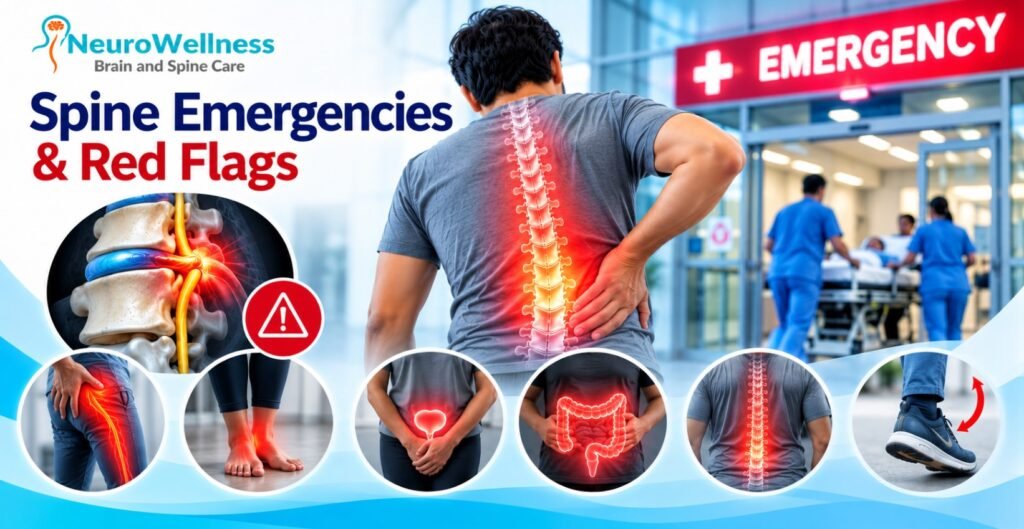
 Go to hospital NOW if you have any of these
With back or neck pain, any single one of these can be a spinal emergency. Don’t wait for an appointment.
🚽 Loss of bladder or bowel control, or new difficulty passing urine
🩲 Numbness in the groin, genitals or inner thighs (saddle area)
🦵 Sudden or rapidly worsening weakness in one or both legs
🤕 Severe back/neck pain after a fall, accident or major injury
🌡️ Back pain with fever, chills or unexplained weight loss
🚶 New unsteadiness walking, or clumsy hands (cord compression)
Act now: 🚑 Call 108or go straight to your nearest hospital’s emergency department
This is a true emergency call 108 or go to the nearest hospital, not necessarily a NeuroWellness location. Our number below is for general information only, not for emergency dispatch.
The Core Question
When is back pain an emergency?
Back pain is an emergency when it comes with loss of bladder or bowel control, saddle numbness (groin/inner thighs), rapidly worsening or both-leg weakness, severe pain after a major injury, or fever with unexplained weight loss. These can signal cauda equina syndrome, spinal cord compression, fracture, infection or tumour — all of which need urgent care. When in doubt, it’s safer to be checked and told it’s nothing than to wait.
The reassuring truth: the vast majority of back and neck pain is not an emergency. The signs below are uncommon but knowing them could protect your long-term function.
🚨 A short, specific list
Only a handful of symptoms count as a true spine emergency.
⏱️ Hours matter, not days
Cauda equina outcomes are best when treated within 24–48 hours.
🚑 Nearest hospital first
Speed to any emergency department beats travelling to a specific one.
🗣️ Describe symptoms precisely
Say "bladder", "both legs", "numbness" — not just "back pain".
The Most Important One
Cauda Equina Syndrome
🐴 Cauda Equina Syndrome (CES)
Surgical emergency · every hour counts
The cauda equina (“horse’s tail”) is the bundle of nerves at the base of the spine. When it’s compressed usually by a large disc herniation, but also by tumour, fracture or infection it can permanently affect bladder, bowel, sexual function and the legs. Urgent surgery to relieve the pressure, ideally within 24–48 hours, gives the best chance of recovery.
⚠️ Red-flag symptoms (any one needs emergency care)
- Bladder trouble – new difficulty passing urine, not feeling the urge, or leaking (urinary retention is often the earliest sign)
- Bowel trouble – loss of control or not feeling the need to go
- Saddle numbness – reduced or lost sensation in the groin, genitals, buttocks or inner thighs
- Both legs affected – weakness, numbness or sciatica in both legs
- Sexual dysfunction – new loss of genital sensation
What sets it apart from ordinary sciatica is both-sided symptoms plus bladder/bowel or saddle changes. It’s confirmed with an urgent MRI — don’t try to judge it “by feel”. Go to an emergency department and describe the exact symptoms and when they started.
Other signs that can't wait
🧠 Spinal Cord Compression
Urgent · protects walking & function
Pressure on the spinal cord itself — from a disc, severe stenosis, tumour, infection or injury. In people with a history of cancer, new persistent back pain can be the first sign of the cord being compressed by a spinal deposit (metastatic cord compression), and needs urgent imaging.
Warning signs
- Progressive weakness in the arms or legs
- Unsteady, clumsy walking or loss of balance
- Clumsy hands, dropping things
- A “band” of numbness around the trunk
Early treatment protects long-term function seek urgent assessment and MRI.
🤕 Spinal Injury / Fracture
Emergency · don't move the person
After a significant fall, road accident or sports injury — especially in older adults or those with osteoporosis — the spine may be fractured or unstable. Moving someone with a possible spinal injury can cause further harm.
- Do not move the person unless they’re in immediate danger
- Call an ambulance (108) and keep them still
- Support the head/neck in line with the body
- Note any numbness or weakness to tell the paramedics
🌡️ Spinal Infection (with fever)
Prompt assessment needed
Back pain with fever, chills, or unexplained weight loss can indicate a spinal infection such as an abscess or discitis — more likely in people with diabetes, low immunity, or recent infections. An epidural abscess can compress the cord and become an emergency.
Warning signs
- Constant back pain with fever or night sweats
- Pain not relieved by rest, often worse at night
- New weakness or numbness alongside the above
Seek prompt medical assessment — early antibiotics or surgery can be crucial. See also spine infection & TB spine
🎗️ Spinal Tumour Warning Signs
Needs early diagnosis
Most back pain isn’t cancer, but certain patterns deserve prompt review particularly in anyone with a known history of cancer.
- Constant pain that’s worse at night or at rest
- Unexplained weight loss or feeling unwell
- A known history of cancer with new back pain
- Progressive neurological symptoms
Act Fast, Act Right
What to do in a spine emergency
1. Don't wait
Don’t “see if it passes”. With red flags, delay can cause permanent damage.
2. Note the time
When did symptoms start? This guides urgent treatment decisions.
3. Get to the ER
Call 108 or go to the nearest emergency department. Don’t drive yourself if weak.
4. Describe clearly
Say exactly what’s happening urination, numbness, weakness not just “my back hurts”.
Knowing What’s Next
What happens at the hospital for a spine emergency
Knowing what to expect can ease anxiety in an already stressful moment.
1. Triage & exam
Emergency staff will quickly assess vital signs and perform a focused neurological exam testing sensation, reflexes and strength.
2. Urgent imaging
An MRI (or CT if MRI isn’t immediately available) is usually done urgently to confirm the cause and guide the decision on surgery.
3. Specialist decision
A neurosurgeon reviews the scan alongside your symptoms to decide if, and how urgently, surgery is needed.
Bringing a clear timeline of when symptoms started, and any previous scans, helps the team move faster.
For Family & Caregivers
If it's happening to someone else, not you
Watching a family member develop these symptoms is frightening. Here’s how to help effectively.
👂 Listen & note specifics
Ask directly about bladder/bowel control, numbness location and leg strength — specific answers help the medical team act faster than “back pain.”
🚫 Don't move them after a fall
If a fall or injury is involved, keep the person still and call an ambulance rather than trying to move them yourself.
📝 Bring their information
ID, a list of current medicines, and any known conditions (diabetes, cancer, osteoporosis) help the team assess risk quickly.
With the spine, time is function
Just as “time is brain” in a stroke, in a spine emergency time is your ability to walk and control your bladder and bowel. Nerves that are decompressed early recover far better than those left under pressure. If you recognise the red flags, treat it as the emergency it is.
Why NeuroWellness
Neurosurgeon-led emergency spine expertise
Spine emergencies involve the nerves and spinal cord – exactly where neurosurgical expertise matters most.
🧠 Nerve & cord specialists
Spine emergencies involve the nerves and spinal cord precisely a neurosurgeon’s field.
⚡ Rapid assessment
Urgent evaluation and imaging when time-critical decompression may be needed.
📍 In Bengaluru
neurosurgeon-led spine care, with urgent assessment when needed.
COMMON QUESTIONS
Spine Emergency FAQs
Back pain is an emergency when it comes with loss of bladder or bowel control, numbness in the saddle area (groin, genitals, inner thighs), rapidly worsening or both-leg weakness, severe pain after a major injury, or back pain with fever and unexplained weight loss. These can signal cauda equina, cord compression, fracture, infection or tumour — seek emergency care immediately.
Cauda equina syndrome is compression of the bundle of nerves at the base of the spine, usually from a large disc herniation. It causes bladder or bowel dysfunction, saddle numbness and leg weakness, and is a surgical emergency — urgent decompression, ideally within 24–48 hours, gives the best chance of recovery.
The key red flags are new difficulty passing or controlling urine (urinary retention is the earliest sign), loss of bowel control, numbness in the saddle area (groin, genitals, buttocks, inner thighs), weakness or numbness in both legs, and loss of sexual sensation. Any of these with back pain needs emergency evaluation.
Sudden or rapidly worsening leg weakness with back pain can indicate significant nerve or spinal-cord compression from a large disc herniation, tumour, fracture or infection. It’s a warning sign that needs urgent imaging and specialist assessment — do not wait for it to pass.
It can be. Back pain with fever, chills or unexplained weight loss may indicate a spinal infection (such as an abscess) or, rarely, a tumour — especially in people with diabetes, low immunity or a history of cancer. It warrants prompt medical assessment.
Early surgery offers the best chance of recovery, and many people regain good function — but outcomes depend on how much compression occurred and how quickly it was relieved. Some may have lasting changes. This is exactly why acting within hours, not days, matters so much.
Emergency staff will quickly assess you and perform a focused neurological exam, then arrange urgent imaging — usually an MRI, or CT if MRI isn’t immediately available. A neurosurgeon reviews the scan alongside your symptoms to decide how urgently surgery is needed. Bringing a clear timeline of when symptoms started helps the team move faster.
Not an emergency, but worried?
If you don’t have red-flag signs but your symptoms concern you, don’t ignore them either. Book an assessment early diagnosis keeps small problems small.
Medically reviewed by Dr. Ganesh Veerabhadraiah, HOD and Senior Consultant Neurosurgeon, NeuroWellness, Bengaluru. Last reviewed: 21-Oct-2026
Disclaimer: This content is for educational purposes only and is not a substitute for professional medical advice, diagnosis or treatment. Please consult a qualified specialist for guidance appropriate to your condition. Do not use this information for self-diagnosis or self-treatment. In a medical emergency, seek immediate care at the nearest hospital. NeuroWellness does not promote, endorse or recommend any particular doctor or procedure.