Comprehensive Spine Care
Comprehensive Spine Care Guide
A single hub for anyone dealing with neck pain, back pain, a spinal disorder, or a spinal injury organised into seven areas so you can go as deep as you need. Educational content only; see Book a Consultation at the end of the page.
The 7 Pillars of Spine Care
Spine Conditions
What diseases and disorders affect the spine
Symptoms & Warning Signs
What symptoms mean, and which to never ignore
Spine Treatments
From medication and physiotherapy to surgery
Spine Procedures & Surgeries
Detailed explanations of every operation
Prevention & Spine Wellness
Practical, everyday steps to protect your spine
Investigations & Diagnosis
How spine problems are actually diagnosed
Patient Resources
FAQs, reviews, articles & further reading
🩺 Exam before imaging
Diagnosis always starts with a clinical assessment, not a scan.
🧭Surgery-last philosophy
About 90% of spine problems are managed without an operation.
🎯Minimally invasive first
Keyhole, endoscopic and robotic options where suitable.
📍Two Bengaluru locations
Jayanagar and Electronic City, plus online consultations.
Why Spine Health Matters
Spine problems are one of the biggest, most under-discussed public health issues in the world – the reason spine awareness deserves the same attention as heart health or stroke prevention.
#1
619M+
~60–66%
50–54
Spine Conditions
Understanding Your Spine
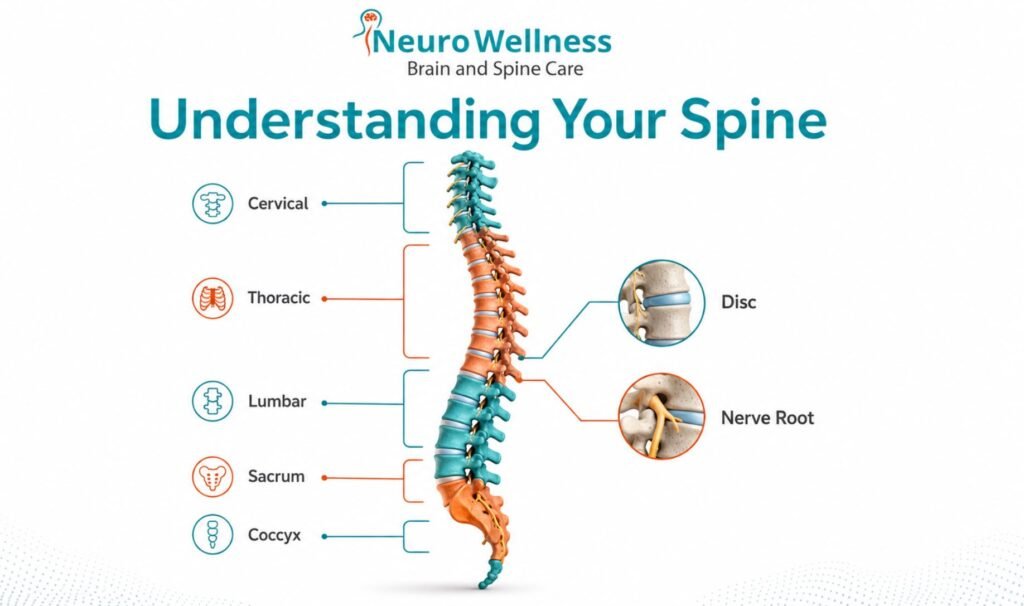
The spine is a stacked column of 33 vertebrae running from the base of the skull to the tailbone, divided into five regions: cervical (neck, 7 vertebrae), thoracic (mid-back, 12 vertebrae), lumbar (lower back, 5 vertebrae), sacrum, and coccyx. Between the vertebrae sit shock-absorbing discs; behind them runs the spinal canal, housing the spinal cord and nerve roots; facet joints guide movement, and ligaments and muscles stabilise the whole column.
Beyond housing the spinal cord, the spine provides structural support, protection, movement, shock absorption, and balance. Because it is under continuous mechanical load throughout life, gradual wear is normal, an MRI finding alone doesn’t always mean disease.
Common Spine Conditions
For the complete in-depth reference, see Spine Conditions & Disorders: A Complete Guide.
Slip Disc (Disc Prolapse)
Disc centre pushes through its outer wall and presses on a nerve
Cervical Spondylosis
Age-related osteoarthritis of the neck
Lumbar Spondylosis
Age-related osteoarthritis of the lower back
Sciatica
Pain radiating from the back through the leg — see Part 2
Spinal Canal Stenosis
Narrowing of the canal squeezing the cord or nerves
Scoliosis
Abnormal sideways curvature of the spine
Kyphosis
Excessive forward rounding of the upper back
Spondylolisthesis
One vertebra slipping forward over another
Spinal Tumors
Primary or metastatic tumours affecting the spine
Spine Infections
Discitis, osteomyelitis, epidural abscess, spinal TB
Osteoporosis- Related Fractures
Compression fractures of weakened vertebrae
Spinal Cord Compression
Pressure on the cord itself – clumsy hands, unsteady gait
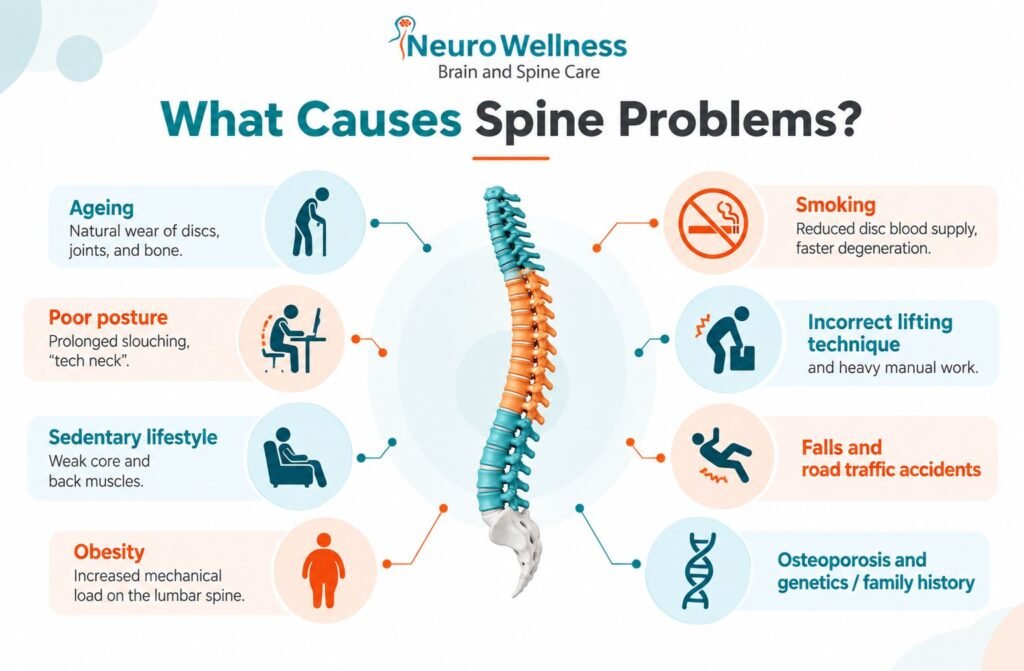
What Causes Spine Problems?
- Ageing – natural wear of discs, joints, and bone
- Poor posture – prolonged slouching, “tech neck”
- Sedentary lifestyle – weak core and back muscles
- Obesity – increased mechanical load on the lumbar spine
- Smoking – reduced disc blood supply, faster degeneration
- Incorrect lifting technique and heavy manual work
- Falls and road traffic accidents
- Osteoporosis and genetics/family history
Part 2
Symptoms & Warning Signs
What symptoms should people never ignore?
Symptom Checker
Most people arrive here trying to understand what they’re feeling, not for a diagnosis. Start here — items marked ⚠ are potential red-flag symptoms.
Any ⚠ item – see Emergency Warning Signs below and seek care immediately.
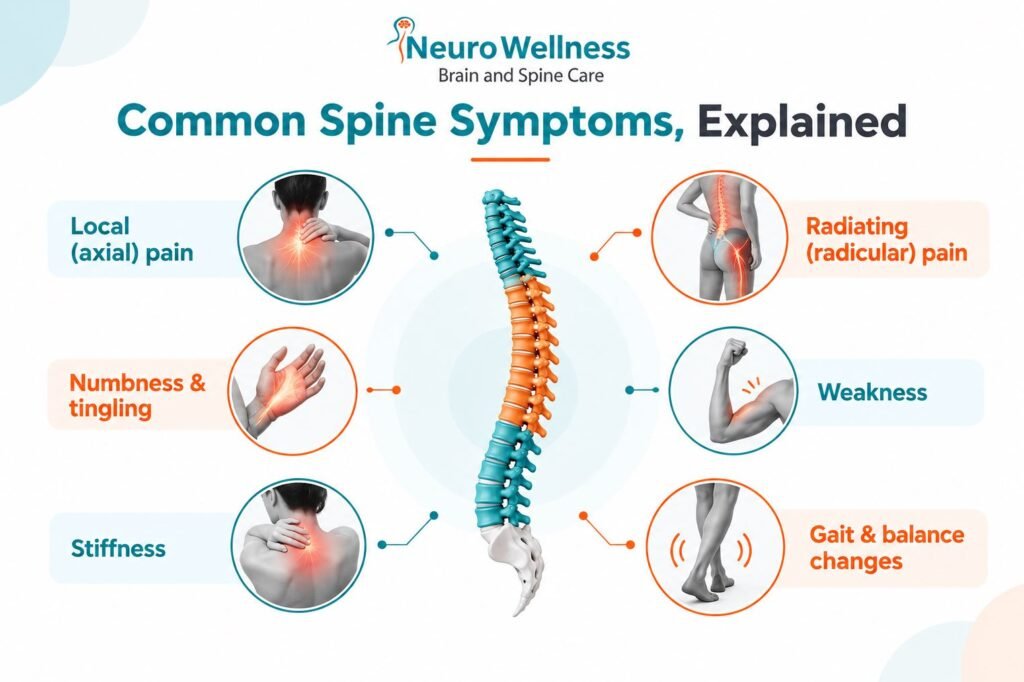
Common Spine Symptoms, Explained
Most people arrive here trying to understand what they’re feeling, not for a diagnosis. Start here — items marked ⚠ are potential red-flag symptoms.
Local (axial) pain
Confined to the neck or back usually muscular, ligament or joint-related.
Radiating (radicular) pain
Travels down an arm or leg usually a compressed nerve root, e.g. sciatica.
Numbness & tingling
Follows a nerve path; helps localise the affected level.
Weakness
Grip difficulty or foot drop needs prompt review.
Stiffness
Morning stiffness that eases with movement can suggest inflammatory arthritis.
Gait & balance change
Clumsy hands or an unsteady walk may indicate spinal cord compression - see a specialist.
Sciatica — A Closer Look
What it is: pain following the sciatic nerve — from the lower back, through the buttock and down one leg. It is a symptom, not a diagnosis in itself.
Common causes: herniated / bulging lumbar disc (most common), lumbar spinal stenosis, spondylolisthesis, piriformis syndrome.
How it typically feels: usually one-sided; burning, shooting or electric-shock-like; often worse with sitting, coughing or straining; may include numbness, tingling or weakness.
How it’s treated: most episodes improve within weeks with staying active, anti-inflammatory medication and physiotherapy. Surgery usually microdiscectomy (see Part 4) – is reserved for severe persistent pain or red-flag features.
When to be more concerned: progressive leg weakness, saddle numbness, or new bladder/bowel symptoms – see Emergency Warning Signs.
Emergency Warning Signs — When Not to Wait
Seek emergency care immediately if you experience:
- New loss of bladder or bowel control
- Numbness in the “saddle” area (inner thighs, buttocks, groin)
- Rapidly worsening weakness or numbness in one or both legs, or sudden paralysis
- Severe neck / back pain after major trauma
- Back / neck pain with fever, unexplained weight loss, or a cancer history
- Sudden difficulty walking, loss of balance, or clumsy hands
Part 3
Spine Treatments
Treatment Options Overview
Most spine conditions respond to non-surgical care. Surgery is a later step, considered when conservative treatment fails or clear indications exist.
Non-Surgical
- Medicines
- Physiotherapy
- Lifestyle modification
- Spine injections (epidural, nerve root block, facet, radiofrequency)
- Rehabilitation
Surgical
- Minimally invasive spine surgery
- Endoscopic spine surgery
- Microsurgery
- Fusion surgery (TLIF/PLIF/ALIF/XLIF)
- Artificial disc replacement
Non-Surgical Treatments in Detail
- Epidural Injection – steroid injected into the epidural space to settle nerve inflammation, commonly used for sciatica
- Nerve Root Block – targeted injection around a specific nerve root, both diagnostic and therapeutic
- Facet Joint Injection – for pain from the small joints connecting adjacent vertebrae
- Radiofrequency Procedures – heat disables small nerves carrying pain from an arthritic facet joint, for longer-lasting relief
- Cervical Collars / Bracing – short-term support, under medical guidance
Understanding Risks & Complications
As with any surgery, spine surgery carries some risk of bleeding, infection, nerve injury or hardware-related issues. Minimally invasive, endoscopic and robotic techniques reduce several of these risks compared with open surgery, but do not eliminate them. A transparent, individualised discussion of risks and benefits is standard practice.
Recovery After Spine Surgery
Day 1
Sit up, walk with assistance
Week 1
Increasing walking, light activity
Month 1
Physiotherapy, most daily tasks
Month 3
Return to office work (typical)
Month 6
Sport/heavy activity reassessed
Part 4
Spine Procedures & Surgeries
Detailed explanations of every operation
Spine Procedures & Surgery - At a Glance
| Procedure | Used for | Approach |
|---|---|---|
| Microdiscectomy (MLD) | Sciatica from a lumbar disc herniation | Minimally invasive |
| Endoscopic discectomy | Disc & nerve compression | Keyhole / day-care |
| ACDF / Cervical disc replacement | Cervical disc disease, nerve / cord compression | Front-of-neck |
| TLIF / PLIF / ALIF / XLIF | Lumbar instability, spondylolisthesis | Fusion (by approach) |
| Laminectomy / Laminoplasty | Spinal canal stenosis | Decompression |
| Vertebroplasty / Kyphoplasty | Osteoporotic compression fractures | Cement stabilisation |
Spine Procedures – Complete List
Non-surgical
- Physiotherapy and structured exercise therapy
- Epidural steroid injection (ESI)
- Facet joint injection
- Selective nerve root block (SNRB)
- Sacroiliac (SI) joint injection
- Radiofrequency ablation
- Cervical collar / lumbar bracing (short-term)
Surgical
- Microdiscectomy (MLD) — see below
- Endoscopic discectomy — see below
- ACDF — see below
- Cervical Disc Replacement — motion-preserving alternative to ACDF
- TLIF — see below
- PLIF — see below
- ALIF — see below
- XLIF — see below
- Laminectomy, Laminoplasty, Foraminotomy
- Vertebroplasty / Balloon Kyphoplasty
- Spinal Fixation & Instrumentation
- Corpectomy
- Tumor Surgery & Spine Trauma Surgery
- Scoliosis / Deformity Correction Surgery
- Robotic-assisted & navigation-guided spine surgery
Minimally Invasive, Robotic & Endoscopic Spine Surgery
Minimally Invasive (MISS)
Small incisions and tubular retractors preserve surrounding muscle.
- Less blood loss & pain
- Shorter hospital stay
- Faster return to work
Robotic Spine Surgery
A 3D surgical plan guides a robotic arm for millimetre-accurate screw placement. It assists — it does not operate independently.
- Greater implant accuracy
- Fewer revision surgeries
- Many walk the same day
Endoscopic Spine Surgery
An HD scope through an incision often under a centimetre treats discs and nerve compression.
- Often day-care / single-night stay
- Low blood loss
- Early return to function
Microdiscectomy (MLD) — Explained in Detail
Microdiscectomy
One of the most frequently performed and successful spine surgeries — the standard treatment for sciatica from a lumbar disc herniation unresponsive to conservative care.
| Treats | A herniated lumbar disc pressing on a nerve root, causing persistent leg pain, numbness, or weakness despite approximately 6 weeks of conservative treatment. |
|---|---|
| How it’s done | A 2–3 cm incision is made. An operating microscope is used with gentle muscle retraction, and only the disc fragment pressing on the nerve is removed. |
| What to expect | Often performed as a day-care procedure or with a single-night stay. Walking is usually possible the same day. Desk work may resume in 2–4 weeks, while heavy lifting is generally restricted for 6–8 weeks. |
| Risks | Infection, bleeding, dural tear, and a small chance of disc recurrence at the same level. |
TLIF & PLIF (Lumbar Interbody Fusion) — Explained in Detail
TLIF & PLIF
The two most common techniques for lumbar spinal fusion — joining vertebrae to eliminate painful / unstable movement and relieve nerve compression.
| Treats | Spondylolisthesis, lumbar stenosis with instability, recurrent disc herniation, degenerative disc disease with instability. |
|---|---|
| TLIF | Approach from one side through the neural foramen — less nerve retraction. |
| PLIF | Approach from the back on both sides — slightly more retraction. |
| What to expect | 2–4 day stay (shorter with MISS / robotic); walking from day one; fuller activity guided by fusion confirmation over 3–6 months. |
| Risks | General risks plus hardware complications, non-fusion, and long-term adjacent-segment stress. |
ALIF & XLIF — Explained
ALIF & XLIF
Two further lumbar fusion techniques, distinguished by the direction of surgical approach.
| ALIF | Anterior Lumbar Interbody Fusion — through a small lower-abdomen incision to reach the disc space, most often L5–S1 or L4–5. Avoids the back muscles and nerves and allows a larger implant to restore disc height and lordosis. Often performed with a vascular access surgeon. |
|---|---|
| XLIF | Extreme / Lateral Lumbar Interbody Fusion — from the patient’s side through the psoas muscle, with continuous nerve monitoring. Allows a large cage and is often combined with posterior screws. Temporary thigh numbness or weakness is possible and usually settles over weeks. |
| Choosing | Depends on the spinal level, patient’s anatomy, and surgeon’s assessment — there is no single “best” approach for every patient. |
Other Spine Procedures
- Laminectomy — removes part of the lamina to relieve spinal canal stenosis
- Laminoplasty — reshapes rather than removes the lamina (cervical spine)
- Foraminotomy — enlarges the nerve exit tunnel
- Vertebroplasty / Balloon Kyphoplasty — cement stabilisation of osteoporotic fractures
- Spinal fixation & instrumentation — screws, rods, plates; often navigation / robot-guided
- Corpectomy — vertebral body removal with reconstruction
- Tumor & spine trauma surgery — from biopsy or stabilisation to complex resection and fixation
Part 5
Prevention & Spine Wellness
Practical, everyday steps to protect your spine
Building a Lifelong Healthy Spine
- Healthy Weight: Reduces mechanical load on the lumbar spine
- Core Strengthening: Planks, bridges, pelvic tilts 3–4x/week
- Spine Exercises: Stretching, core work, low-impact cardio
- Bone Health: Calcium, Vitamin D, weight-bearing exercise
- Weight Reduction: Even modest loss reduces lumbar load
- Avoid Smoking: Smoking accelerates disc degeneration
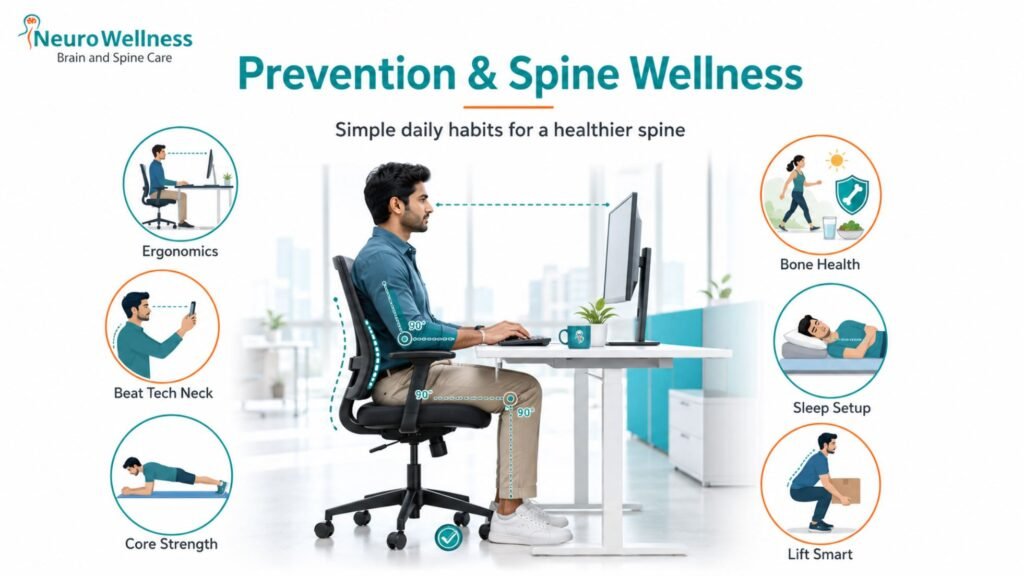
Spine Wellness at Work
Ergonomics & Office Sitting Posture. An ergonomic workstation — screen at eye level, feet flat on the floor, lumbar support — with a movement break every 30–45 minutes makes a measurable difference for Bengaluru’s desk-bound IT and corporate workforce.
Mobile Neck Prevention (“Tech Neck”). Holding the phone at eye level where possible, and taking frequent breaks, reduces neck strain from prolonged phone use.
Workplace Spine Care. Structured ergonomics assessments and spine-awareness sessions for organisations can reduce absenteeism linked to musculoskeletal complaints.
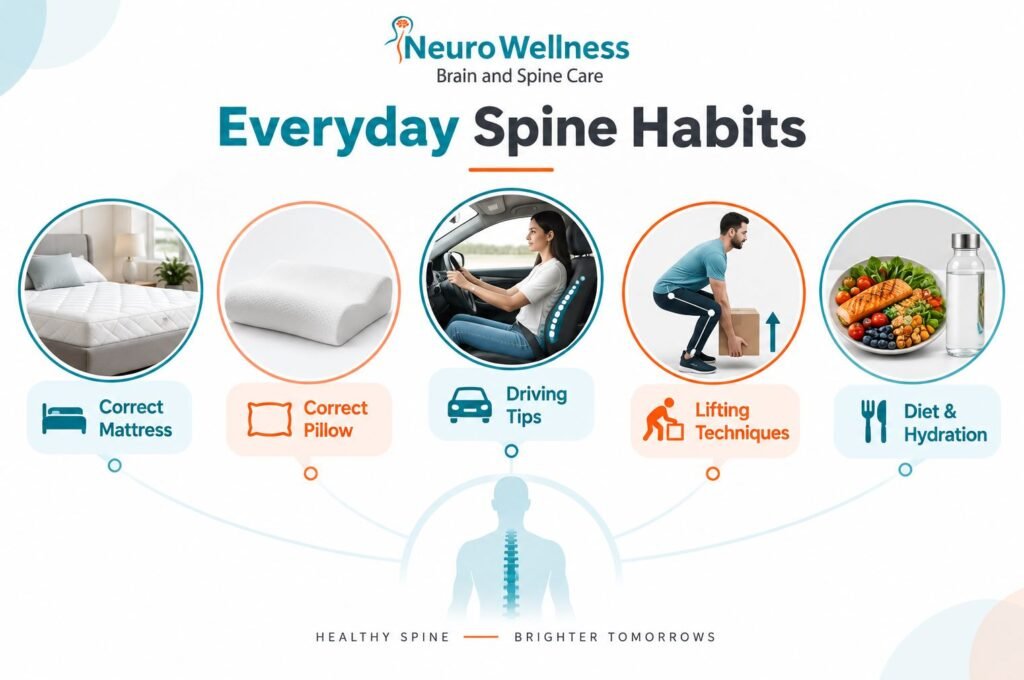
Everyday Spine Habits
- Correct Mattress: Medium-firm, supporting the spine’s natural curve; an old, sagging mattress is an under-recognised cause of morning stiffness.
- Correct Pillow: Keeps the neck neutral; side sleepers generally need a thicker pillow than back sleepers.
- Driving Tips: Knees level with hips, lumbar support, seat close enough to avoid reaching; break every 1–2 hours.
- Lifting Techniques: Bend at the knees and hips, keep the load close, avoid twisting — one of the most effective injury-prevention habits.
- Diet & Hydration: An anti-inflammatory diet, adequate protein and good hydration support disc health; discs are largely water and lose hydration with age and dehydration.
Part 6
Investigations & Diagnosis
How spine problems are actually diagnosed
How Spine Conditions Are Diagnosed
Clinical Exam
History + physical tests (e.g. straight-leg raise) localise the problem first.
X-ray
Shows bones, alignment, fractures and instability.
MRI
The gold standard for discs, nerves and the spinal cord.
CT scan
Detailed bone imaging, useful before surgery.
DEXA scan
Measures bone density to assess osteoporosis risk.
EMG / NCV
Nerve conduction tests to confirm nerve involvement.
Part 7
Patient Resources
Why NeuroWellness, reviews, FAQs & further reading
A specialist-led, surgery-last approach
🩺 Neurosurgeon-led
Spine care led by a neurosurgeon — especially valuable when nerves or the spinal cord are involved.
🧭 Non-surgical first
We explain conservative options before surgery, and only recommend an operation when it's genuinely needed.
🔬 Modern techniques
Minimally invasive, endoscopic and navigation/robot-assisted spine surgery for faster recovery
📍 Two Bengaluru locations
Jayanagar (South Bengaluru) and Kauvery Hospital, Electronic City — with second-opinion consultations available.
Frequently Asked Questions About Spine Care
Spine care is the complete management of spine health — from diagnosing and treating conditions like back pain, neck pain, sciatica and slipped disc, to prevention, physiotherapy, minimally invasive surgery and recovery. Most spine problems are managed without surgery.
In most cases, no. The majority of back pain, sciatica and early degenerative disc disease improve with physiotherapy, medication, posture correction and lifestyle changes. Surgery is considered only when conservative treatment fails or clear red-flag signs are present.
Yes. Most disc herniations settle within a few weeks to months with staying active, anti-inflammatory medication and physiotherapy. Surgery such as microdiscectomy is reserved for severe, persistent pain or nerve weakness.
Both treat spine conditions. A neurosurgeon’s expertise is particularly valuable when the spinal cord or nerves are involved. At NeuroWellness, spine care is led by Dr. Ganesh Veerabhadraiah, Senior Consultant Neurosurgeon in Bengaluru.
See a spine specialist if back or neck pain lasts more than a few weeks, radiates into an arm or leg, or comes with numbness or weakness. Seek emergency care immediately for loss of bladder/bowel control, saddle numbness, or rapidly worsening leg weakness.
Most short-term back pain does not need an MRI. It is recommended when pain persists despite treatment, when there is nerve pain, weakness or numbness, or when red-flag symptoms suggest a serious cause.
Microdiscectomy removes a disc fragment without fusion. ACDF fuses cervical vertebrae via a front-of-neck approach. TLIF, PLIF, ALIF and XLIF are lumbar fusion techniques distinguished by approach direction — one side of the back, both sides of the back, the front of the abdomen, or the side through the psoas muscle.
Robotic guidance improves accuracy of screw and implant placement. The robot assists and guides the surgeon — it does not operate independently.
More questions are answered across our spine resources and each condition guide.
What patients say
I have consulted Dr. Ganesh for my mother’s back pain. He is an excellent doctor. I will recommend him for anyone looking for spine specialist.
— Yalaguresh Jorapur, Google
I was in very bad back pain more than year.
After i visited Dr ganesh Veerabhadraiah neuro surgeon spine surgeon. Am really happy with the way I have been treated.the pain and discomfort faded away.thankyou so much sir.
— Yesu Raj, Google
I had been suffering from upper and lower back pain since 2 years.Dr ganesh veerabhadraiah spine surgeon.most caring and understanding
Pain specialist now m alright thankyou doctor
— Pramod M, Google
Related Articles
Get a clear answer about your spine
If you’re dealing with neck pain, back pain, sciatica, a slipped disc or you’ve been advised to consider spine surgery, an accurate diagnosis and an honest conversation about your options is the right next step.
Important disclaimer: The information on this page is for general educational purposes only and does not constitute medical advice. It is not a substitute for professional diagnosis or treatment. If you are experiencing any red-flag symptoms, seek emergency medical care immediately.